FAQs on Newer Antiplatelet Drugs
FAQs on Newer Antiplatelet Drugs, written at SS / DM cardiology level, with concise but exam-oriented explanations. Content is trial-anchored, mechanism-driven, and viva-ready.
GENERAL PRINCIPLES
1. What defines a “newer” antiplatelet drug?
Answer: Agents with greater potency, faster onset, more predictable pharmacodynamics, or novel targets compared with clopidogrel and aspirin (e.g., ticagrelor, prasugrel, cangrelor, vorapaxar).
2. Why did clopidogrel lose primacy in ACS?
Answer: Variable activation (CYP2C19 polymorphism), delayed onset, and higher ischemic events compared with newer P2Y₁₂ inhibitors in trials (PLATO, TRITON).
3. Which pathway do most newer agents target?
Answer: P2Y₁₂ receptor inhibition (prasugrel, ticagrelor, cangrelor); newer agents also target PAR-1 (vorapaxar).
4. What is the fundamental trade-off with newer agents?
Answer: Greater ischemic protection at the cost of higher bleeding risk, requiring patient-specific selection.
5. Which trial first showed mortality benefit with a P2Y₁₂ inhibitor?
Answer: PLATO (ticagrelor vs clopidogrel).
TICAGRELOR
6. What makes ticagrelor pharmacologically unique?
Answer: Reversible, direct P2Y₁₂ inhibition without hepatic activation + adenosine reuptake (ENT-1) inhibition.
7. Why does ticagrelor reduce mortality beyond MI reduction?
Answer: Increased adenosine → vasodilation, anti-inflammatory, anti-ischemic, and microcirculatory benefits (PLATO hypothesis).
8. Why is ticagrelor given twice daily?
Answer: Short plasma half-life (~7–9 hours) and reversible receptor binding.
9. Mechanism of ticagrelor-induced dyspnea?
Answer: Adenosine-mediated stimulation of pulmonary vagal C-fibers, not bronchospasm or LV failure.
10. Why does ticagrelor cause ventricular pauses?
Answer: Adenosine effect on AV nodal conduction (usually early, asymptomatic).
11. Which patients should avoid ticagrelor?
Answer: Severe asthma/COPD with dyspnea intolerance, advanced bradyarrhythmias without pacing, high bleeding risk.
12. Ticagrelor and renal failure—safe or not?
Answer: Safe; no dose adjustment needed, unlike prasugrel (caution) or GP IIb/IIIa inhibitors.
13. Why does ticagrelor increase uric acid?
Answer: Altered adenosine metabolism leading to increased urate production.
14. Which trial supports long-term ticagrelor beyond 1 year?
Answer: PEGASUS-TIMI 54 (60 mg BID post-MI).
15. Key limitation of long-term ticagrelor therapy?
Answer: Bleeding and dyspnea, limiting widespread prolonged use.
PRASUGREL
16. How does prasugrel differ from clopidogrel?
Answer: Single-step activation, more potent and predictable platelet inhibition.
17. Key benefit of prasugrel in TRITON-TIMI 38?
Answer: Marked reduction in stent thrombosis and MI.
18. Why is prasugrel contraindicated in prior stroke/TIA?
Answer: Excess intracranial hemorrhage observed in TRITON.
19. Which populations need caution with prasugrel?
Answer: Age ≥75 years, body weight <60 kg (dose reduction or avoidance).
20. Does prasugrel reduce mortality?
Answer: No clear mortality benefit, despite ischemic reduction.
21. Why is prasugrel preferred in diabetics undergoing PCI?
Answer: Greater absolute ischemic benefit seen in diabetic subgroup (TRITON).
22. Prasugrel vs ticagrelor—key differentiator?
Answer: Prasugrel = irreversible, once daily; Ticagrelor = reversible, BID, adenosine effects.
23. When is prasugrel superior to ticagrelor?
Answer: PCI-treated ACS without stroke/TIA, especially younger, heavier patients.
24. Why must coronary anatomy be known before prasugrel?
Answer: Risk of surgical bleeding if urgent CABG is needed.
CANGRELOR
25. What makes cangrelor unique among P2Y₁₂ inhibitors?
Answer: Intravenous, immediate onset and offset.
26. Key trial supporting cangrelor?
Answer: CHAMPION PHOENIX.
27. Main benefit shown in CHAMPION PHOENIX?
Answer: Reduction in periprocedural MI and stent thrombosis, not mortality.
28. Why is cangrelor ideal in primary PCI?
Answer: Bypasses delayed gastric absorption and vomiting seen in STEMI.
29. Platelet recovery time after stopping cangrelor?
Answer: ~60 minutes.
30. Best role of cangrelor in practice?
Answer: Cath-lab only use, P2Y₁₂ bridging before surgery.
31. Can cangrelor replace oral P2Y₁₂ long term?
Answer: No—IV only, procedural drug.
VORAPAXAR
32. What receptor does vorapaxar inhibit?
Answer: PAR-1 (thrombin receptor) on platelets.
33. Key trial for vorapaxar?
Answer: TRA 2°P–TIMI 50.
34. Why is vorapaxar not used in ACS?
Answer: Excess intracranial hemorrhage without acute benefit.
35. Who derived net harm with vorapaxar?
Answer: Patients with prior stroke/TIA.
36. Current niche for vorapaxar?
Answer: Highly selected stable CAD/PAD patients with low bleeding risk.
37. Can vorapaxar be combined with DAPT?
Answer: Generally avoided due to bleeding; triple therapy only in rare cases.
COMPARATIVE & STRATEGIC QUESTIONS
38. Which newer antiplatelet is unaffected by CYP polymorphism?
Answer: Ticagrelor (prasugrel minimally affected).
39. Which agent has the fastest oral onset?
Answer: Ticagrelor.
40. Which agent has the longest platelet inhibition duration?
Answer: Prasugrel (irreversible, platelet lifespan).
41. Which agent is safest if urgent surgery anticipated?
Answer: Cangrelor (stop → rapid recovery).
42. Which drug improves outcomes regardless of stent type?
Answer: Ticagrelor (PLATO consistency).
43. Which agent has the highest bleeding risk per unit ischemic gain?
Answer: Prasugrel.
44. Which newer agent reduces stroke in ACS?
Answer: Ticagrelor (PLATO).
45. Which agent worsens outcomes if used indiscriminately?
Answer: Vorapaxar.
46. Best P2Y₁₂ in ACS with renal failure?
Answer: Ticagrelor.
47. Best agent if oral loading not possible?
Answer: Cangrelor.
48. Which agent requires dose reduction by weight?
Answer: Prasugrel.
49. Which agent increases ventricular pauses early?
Answer: Ticagrelor.
50. Which agent shows no mortality benefit despite potent inhibition?
Answer: Prasugrel.
FUTURE & EXAM PEARLS
51. What is selatogrel?
Answer: Subcutaneous, ultra-rapid P2Y₁₂ inhibitor under investigation for early ACS.
52. Why are GPVI inhibitors promising?
Answer: Target collagen-mediated thrombosis with potentially less bleeding.
53. Why are GP IIb/IIIa inhibitors declining?
Answer: High bleeding risk + availability of potent oral/IV P2Y₁₂ agents.
54. What is de-escalation therapy?
Answer: Switching from potent P2Y₁₂ to clopidogrel after acute phase to reduce bleeding.
55. Role of platelet function testing today?
Answer: Selective, mainly for de-escalation strategies.
56. Genotype-guided antiplatelet therapy—current status?
Answer: Emerging; not yet universal but exam-relevant.
57. Why is aspirin still retained in DAPT?
Answer: Synergistic inhibition of TXA₂ pathway.
58. Why does stronger platelet inhibition not always reduce mortality?
Answer: Competing risk of bleeding offsets ischemic gains.
59. Most common cause of discontinuation of ticagrelor?
Answer: Dyspnea.
60. One-line exam rule for newer antiplatelets?
Answer:
ACS + PCI → Ticagrelor/Prasugrel; no oral load → Cangrelor; stable low-bleed → consider Vorapaxar (rare).
Each line is single-sentence, fact-dense, and viva-oriented.
GENERAL
- Newer antiplatelets provide stronger, faster, and more predictable platelet inhibition than clopidogrel.
- The dominant target of modern antiplatelet therapy is the P2Y₁₂ receptor.
- Greater platelet inhibition improves ischemic outcomes but increases bleeding risk.
- Clopidogrel variability is mainly due to CYP2C19 polymorphisms.
- Mortality benefit among P2Y₁₂ inhibitors is drug-specific, not class-wide.
TICAGRELOR
- Ticagrelor is a reversible, direct P2Y₁₂ inhibitor.
- Ticagrelor does not require hepatic activation.
- PLATO demonstrated mortality reduction with ticagrelor in ACS.
- Ticagrelor increases adenosine by inhibiting ENT-1 transporters.
- Adenosine explains ticagrelor-related dyspnea.
- Ticagrelor-induced dyspnea occurs without hypoxia or bronchospasm.
- Ticagrelor may cause early, transient ventricular pauses.
- Ticagrelor requires twice-daily dosing due to short half-life.
- Ticagrelor is effective irrespective of CYP genotype.
- Ticagrelor increases serum uric acid levels.
- PEGASUS supports long-term low-dose ticagrelor post-MI.
- Bleeding is the main limitation of prolonged ticagrelor therapy.
- Ticagrelor requires no dose adjustment in renal failure.
PRASUGREL
- Prasugrel is an irreversible thienopyridine P2Y₁₂ inhibitor.
- Prasugrel undergoes single-step metabolic activation.
- TRITON-TIMI 38 showed prasugrel reduced stent thrombosis.
- Prasugrel does not confer mortality benefit despite ischemic reduction.
- Prasugrel is contraindicated in prior stroke or TIA.
- Intracranial bleeding risk limits prasugrel use.
- Prasugrel shows greater benefit in diabetics undergoing PCI.
- Prasugrel should be avoided or dose-reduced in patients <60 kg.
- Elderly patients have higher bleeding risk with prasugrel.
- Coronary anatomy should be known before prasugrel initiation.
CANGRELOR
- Cangrelor is an intravenous, reversible P2Y₁₂ inhibitor.
- Cangrelor has immediate onset and rapid offset of action.
- Platelet function recovers within one hour after stopping cangrelor.
- CHAMPION PHOENIX showed reduced periprocedural ischemic events.
- Cangrelor does not reduce long-term mortality.
- Cangrelor bypasses gastrointestinal absorption.
- Cangrelor is ideal in primary PCI without oral loading.
- Cangrelor is useful as a bridging agent before surgery.
- Cangrelor is not suitable for long-term therapy.
VORAPAXAR
- Vorapaxar is a protease-activated receptor-1 antagonist.
- Vorapaxar inhibits thrombin-mediated platelet activation.
- TRA 2°P–TIMI 50 evaluated vorapaxar in secondary prevention.
- Vorapaxar increases intracranial hemorrhage risk.
- Vorapaxar is contraindicated in prior stroke or TIA.
- Vorapaxar has no role in acute coronary syndromes.
- Vorapaxar may be considered in selected stable CAD or PAD patients.
COMPARATIVE & EXAM PEARLS
- Ticagrelor is the only P2Y₁₂ inhibitor with proven mortality benefit.
- Prasugrel provides the strongest irreversible platelet inhibition.
- Cangrelor has the fastest onset of action among all antiplatelets.
- Ticagrelor has the fastest onset among oral agents.
- Prasugrel has the longest duration of platelet inhibition.
- Ticagrelor causes more dyspnea than other P2Y₁₂ inhibitors.
- Cangrelor is safest when urgent surgery is anticipated.
- Vorapaxar increases bleeding without improving acute outcomes.
- High ischemic risk favors potent P2Y₁₂ inhibition.
- High bleeding risk favors de-escalation to clopidogrel.
- Platelet function testing is mainly used for de-escalation strategies.
- Genotype-guided therapy is emerging but not routine.
- GP IIb/IIIa inhibitors are declining due to bleeding risk.
- GPVI inhibitors may offer antithrombotic benefit with less bleeding.
- Aspirin remains foundational due to thromboxane A₂ inhibition.
- ACS + PCI → ticagrelor or prasugrel; no oral load → cangrelor.
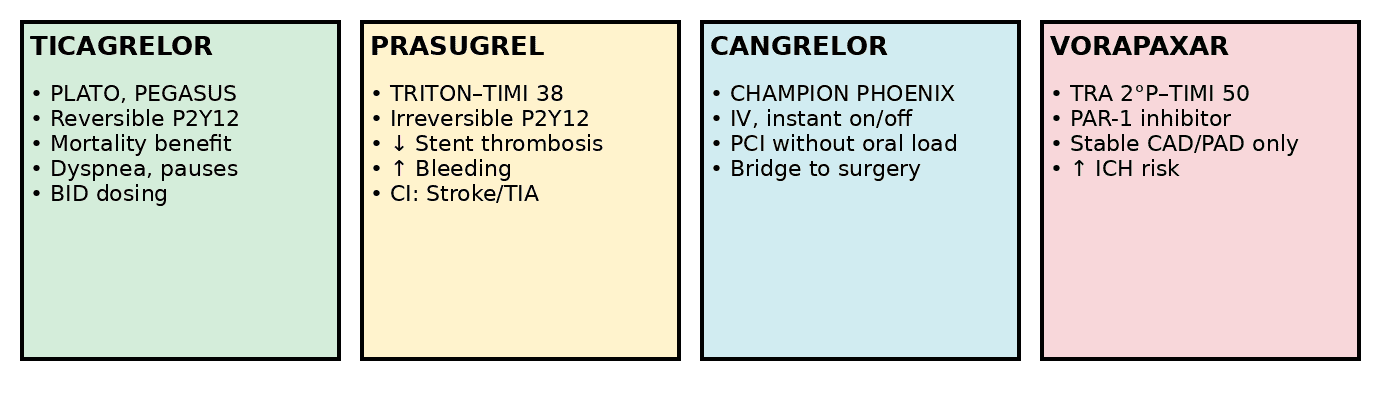
Newer Antiplatelet Drugs — Ultra-High-Yield Comparison Table
| Feature | Ticagrelor | Prasugrel | Cangrelor | Vorapaxar |
|---|---|---|---|---|
| Drug class | Non-thienopyridine P2Y₁₂ inhibitor | Thienopyridine P2Y₁₂ inhibitor | IV P2Y₁₂ inhibitor | PAR-1 antagonist |
| Reversibility | Reversible | Irreversible | Reversible | Irreversible |
| Route | Oral | Oral | Intravenous | Oral |
| Onset | Rapid (oral) | Rapid (oral) | Immediate (seconds) | Slow |
| Offset | Fast (3–5 days) | Slow (platelet lifespan) | Very fast (~60 min) | Very slow |
| Metabolic activation | Not required | Required (single step) | Not required | Not required |
| Key trials | PLATO, PEGASUS | TRITON–TIMI 38 | CHAMPION PHOENIX | TRA 2°P–TIMI 50 |
| Mortality benefit | Yes | No | No | No |
| Major ischemic benefit | ↓ MI, ↓ stroke | ↓ Stent thrombosis | ↓ Periprocedural MI | ↓ Events in stable CAD/PAD |
| Major bleeding risk | Moderate | High | Moderate | Very high (ICH) |
| Unique adverse effect | Dyspnea, pauses, ↑ uric acid | ICH | Dyspnea (rare) | Intracranial hemorrhage |
| Stroke/TIA contraindication | No | Yes | No | Yes |
| Renal dose adjustment | Not required | Caution | Not required | Not required |
| Dosing frequency | BID | OD | Continuous infusion | OD |
| Use in ACS | First-line | First-line (PCI only) | Cath-lab only | No |
| Use in PCI without oral load | No | No | Yes (best choice) | No |
| Use as bridging agent | No | No | Yes | No |
| Use in stable CAD/PAD | Selected | Rare | No | Selected only |
| Exam one-liner | Only P2Y₁₂ with mortality benefit | Best at preventing stent thrombosis | IV P2Y₁₂ with instant on/off | Thrombin blocker with ICH risk |