Alcohol Septal Ablation
Alcohol Septal Ablation (ASA), aligned with ACC/AHA + ESC guidance and real-world cath-lab practice.
Alcohol Septal Ablation (ASA)
Purpose: Percutaneous reduction of LVOT obstruction in hypertrophic obstructive cardiomyopathy (HOCM) by inducing a controlled septal infarction.
1. Indications
Mandatory Criteria (ALL should be present)
- Symptomatic HOCM
- NYHA III–IV or recurrent exertional syncope/angina
- Symptoms refractory to optimal medical therapy
(β-blockers ± verapamil ± disopyramide)
- Hemodynamically significant LVOT obstruction
- Resting LVOT gradient ≥ 50 mmHg
- OR provoked gradient ≥ 50 mmHg (Valsalva/exercise)
- Anatomical suitability
- Septal hypertrophy ≥ 15 mm
- Discrete septal perforator supplying basal septum
- SAM-mediated obstruction (not mid-ventricular)
- Patient profile favoring ASA
- Age >40–50 years
- High surgical risk / patient preference
- Prior cardiac surgery
2. Contraindications
Absolute Contraindications
❌ Non-obstructive HCM
❌ No suitable septal perforator artery
❌ Intrinsic mitral valve disease requiring surgery
❌ Mid-ventricular obstruction without LVOT gradient
❌ Severe CAD needing CABG
❌ Children / young adults (<30–35 yrs)
❌ Apical HCM
Relative Contraindications
⚠ Basal septum <15 mm
⚠ Diffuse septal hypertrophy
⚠ Existing high-grade AV block
⚠ Multiple septal perforators (incomplete targeting)
⚠ Prior ASA with failed result
3. Technique (Step-by-Step Cath-Lab Approach)
Pre-Procedure
- Echo (rest + provocation)
- Coronary angiography
- Temporary pacing wire (RV) mandatory
- Invasive LVOT gradient measurement
Procedure Steps
1. Identify target septal perforator
- Usually 1st septal branch of LAD
- Supplies basal interventricular septum
2. Balloon occlusion
- Over-the-wire balloon inflated in septal branch
- Confirm occlusion angiographically
3. Myocardial contrast echocardiography (CRITICAL)
- Inject echo contrast via balloon lumen
- Confirm enhancement of basal septum only
- ❌ No RV free wall / papillary muscle / LV free wall staining
4. Alcohol injection
- 1–3 mL of absolute ethanol (95–100%)
- Slow injection over 1–3 minutes
- Balloon remains inflated for 5–10 min
5. Post-infarct assessment
- Immediate LVOT gradient reassessment
- Expect partial acute reduction
- Final result evolves over weeks (septal thinning)
4. Expected Hemodynamic Effects
| Parameter | Immediate | 3–6 months |
|---|---|---|
| LVOT gradient | ↓ 30–50% | ↓ 70–90% |
| Septal thickness | No change | ↓ 30–40% |
| NYHA class | Partial | Marked improvement |
5. Results & Outcomes
Efficacy
- Symptom improvement (NYHA I–II): 80–90%
- Gradient reduction: Comparable to surgery (long-term)
- Exercise capacity: Improves significantly
Complications
| Complication | Incidence |
|---|---|
| Complete heart block | 10–20% |
| Permanent pacemaker | 5–15% |
| Ventricular arrhythmias | Rare |
| Septal rupture | Very rare |
| Mortality (experienced centers) | <1% |
6. ASA vs Surgical Myectomy (Exam-Critical)
| Feature | ASA | Myectomy |
|---|---|---|
| Invasiveness | Percutaneous | Open heart |
| Pacemaker risk | Higher | Lower |
| Residual gradient | Slightly higher | Lowest |
| Mitral repair | ❌ | ✅ |
| Young patients | ❌ | ✅ |
| Long-term data | Moderate | Extensive |
👉 Myectomy = Gold standard in young, low-risk patients
👉 ASA = Preferred in older / high-risk patients
7. Guideline Position
ACC/AHA
- ASA reasonable alternative to myectomy
- Class IIa in experienced centers
ESC
- ASA acceptable in older patients with suitable anatomy
- Emphasis on center expertise
Key Exam Pearls
🔑 ASA causes controlled septal infarction
🔑 Pacemaker requirement = most common complication
🔑 Myocardial contrast echo is mandatory
🔑 Not suitable for mid-ventricular obstruction
🔑 Symptom improvement precedes maximal gradient reduction
50 ULTRA-HARD ONE-LINER TRAPS – ASA
- ASA improves LVOT obstruction by creating infarction, not by reducing contractility.
- Immediate LVOT gradient fall post-ASA is due to septal stunning, not thinning.
- Maximal gradient reduction occurs weeks to months, not in cath-lab.
- Myocardial contrast echocardiography is mandatory, not optional.
- ASA fails when the wrong septal perforator is selected, regardless of alcohol dose.
- Complete heart block is due to His-bundle injury, not AV nodal ischemia alone.
- Baseline LBBB predicts post-ASA permanent pacemaker requirement.
- Post-ASA ECG most commonly shows new RBBB.
- ASA produces a localized transmural septal scar, not diffuse fibrosis.
- Alcohol volume >3 mL increases complications without improving success.
- ASA is contraindicated in mid-ventricular obstruction despite high gradients.
- Asymptomatic LVOT obstruction is never an indication for ASA.
- Apical HCM lacks a septal target → absolute ASA contraindication.
- SAM-mediated MR improves after ASA; degenerative MR does not.
- Balloon occlusion alone can transiently reduce gradient before alcohol injection.
- ASA should not be performed without temporary pacing in situ.
- CK-MB rise confirms infarction but does not predict clinical success.
- Failure of gradient reduction at 6 months defines procedural failure, not day-1 gradient.
- Repeat ASA is driven by residual LVOT gradient, not symptom persistence alone.
- ASA does not reduce sudden cardiac death risk intrinsically.
- Long-term mortality after ASA is comparable to myectomy in experienced centers.
- Surgical myectomy remains preferred in young patients due to scar-related arrhythmia concerns.
- ASA is a Class IIa recommendation, not Class I.
- Septal thickness <15 mm predicts poor ASA response.
- Multiple small septal branches increase risk of uncontrolled infarction.
- ASA should be avoided when concomitant CABG is required.
- Improvement in NYHA class precedes maximal septal thinning.
- Alcohol septal ablation is disease-modifying for obstruction, not palliative.
- ASA does not treat diastolic dysfunction unrelated to obstruction.
- Reduction of SAM, not septal thickness alone, correlates with MR improvement.
- Provoked LVOT gradient ≥50 mmHg is equivalent to resting gradient for indication.
- Disopyramide should be stopped pre-procedure to unmask true obstruction.
- LVOT gradient, not EF, is the best echo marker of ASA success.
- Alcohol injection into non-septal territory risks papillary muscle infarction.
- Ventricular arrhythmias post-ASA are rare compared with conduction disturbances.
- Septal perforator origin from LAD is typical; RCA supply is unsuitable.
- ASA does not eliminate need for ICD when SCD risk factors persist.
- Residual MR post-ASA suggests non-SAM mechanism.
- Surgical backup is essential during ASA due to mechanical complications risk.
- ASA is most effective in discrete basal septal hypertrophy.
- Alcohol septal ablation creates intentional MI, unlike myectomy.
- Gradient reduction alone does not guarantee symptom relief if diastolic stiffness persists.
- Elderly patients benefit more from ASA due to lower remodeling demands.
- Septal rupture is rare but catastrophic → usually from excessive alcohol volume.
- ASA does not correct abnormal papillary muscle insertion.
- Failure to abolish SAM predicts persistent LVOT obstruction.
- ASA success depends more on anatomy than operator aggression.
- Pacemaker implantation after ASA reflects location, not volume, of infarction.
- ASA should be done only in high-volume HCM centers.
- Ultimate goal of ASA is symptom relief via LVOT gradient reduction, not septal thinning per se.
ULTRA-HARD CASE VIGNETTES (ASA)
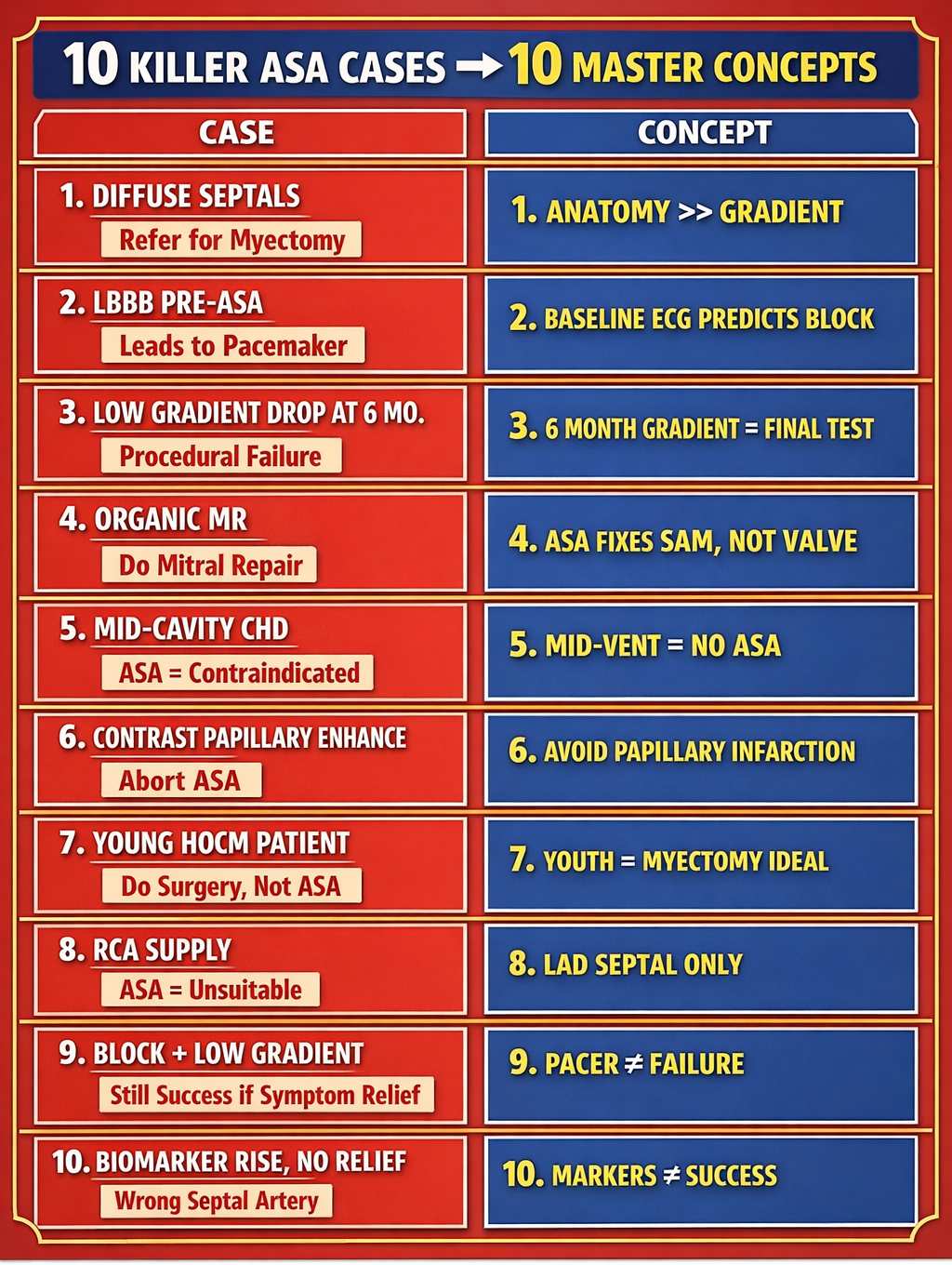
CASE 1 — “The False Green Light”
A 56-year-old man with HOCM has NYHA III dyspnea despite maximal β-blocker and disopyramide therapy.
Echo shows:
- Septal thickness: 19 mm
- Resting LVOT gradient: 62 mmHg
- SAM with posteriorly directed MR
Coronary angiography shows two small septal perforators supplying a broad area of septum.
Myocardial contrast echo shows diffuse septal enhancement.
❓ Best next step?
Answer: ❌ Do NOT perform ASA → refer for surgical myectomy
🔍 Trap logic:
Adequate gradient ≠ suitable anatomy. Diffuse septal supply → uncontrolled infarction.
CASE 2 — “ECG Decides the Outcome”
A 63-year-old woman undergoes ASA. Pre-procedure ECG shows baseline LBBB.
Post-alcohol injection, she develops complete AV block.
❓ What is the most likely long-term outcome?
Answer: 🔌 Permanent pacemaker implantation
🔍 Trap logic:
ASA commonly causes RBBB → baseline LBBB = complete heart block.
CASE 3 — “Immediate Success, Long-Term Failure”
Immediately after ASA, LVOT gradient drops from 75 → 20 mmHg.
At 6-month follow-up:
- LVOT gradient: 58 mmHg
- Persistent NYHA III symptoms
❓ Interpretation?
Answer: ❌ Procedural failure
🔍 Trap logic:
Acute drop = stunning. Final success judged at 3–6 months, not cath-lab.
CASE 4 — “The MR Trap”
Echo before ASA shows:
- Severe MR
- Posteriorly directed jet
- Thickened mitral leaflets with prolapse
❓ Best management?
Answer: 🛑 Surgical myectomy with mitral repair
🔍 Trap logic:
ASA improves SAM-related MR only, not intrinsic valve disease.
CASE 5 — “The Mid-Cavity Illusion”
A 48-year-old with HCM has:
- Mid-ventricular gradient: 70 mmHg
- No LVOT gradient
- Apical aneurysm
❓ Role of ASA?
Answer: ❌ Absolutely contraindicated
🔍 Trap logic:
ASA targets basal septum, not mid-ventricular obstruction.
CASE 6 — “ECG After ASA”
Post-procedure ECG shows:
- QRS widening
- rsR′ pattern in V1
- No AV dissociation
❓ Most likely ECG diagnosis?
Answer: ✅ New RBBB
🔍 Trap logic:
Classic post-ASA ECG finding due to septal infarction.
CASE 7 — “Contrast Echo Saves a Life”
During ASA planning, contrast echo via septal balloon shows enhancement of:
- Basal septum
- Papillary muscle
❓ Best action?
Answer: 🛑 Abort ASA
🔍 Trap logic:
Papillary muscle infarction → acute severe MR → catastrophic.
CASE 8 — “Young but Symptomatic”
A 24-year-old athlete with HOCM:
- NYHA III
- LVOT gradient: 80 mmHg
- Ideal septal anatomy
❓ Preferred therapy?
Answer: 🏥 Surgical myectomy
🔍 Trap logic:
Young age → avoid infarct scar → myectomy is gold standard.
CASE 9 — “Biomarkers Mislead”
After ASA:
- CK-MB: markedly elevated
- Troponin T: high
- LVOT gradient unchanged at 6 months
❓ What went wrong?
Answer: ❌ Wrong septal branch selection
🔍 Trap logic:
Biomarker rise ≠ effective septal reduction.
CASE 10 — “The RCA Surprise”
Angiography shows basal septum supplied predominantly by RCA conus branch.
❓ Can ASA be performed?
Answer: ❌ No
🔍 Trap logic:
ASA requires LAD septal perforator → RCA supply unsuitable.
CASE 11 — “Sudden Death Myth”
A patient asks whether ASA reduces sudden cardiac death risk.
❓ Correct counseling?
Answer: ⚠️ No proven SCD risk reduction
🔍 Trap logic:
ASA treats obstruction, not arrhythmogenic substrate.
CASE 12 — “Pacemaker ≠ Failure”
Patient develops complete AV block post-ASA requiring pacemaker, but LVOT gradient falls to 15 mmHg and symptoms resolve.
❓ Interpretation?
Answer: ✅ Successful ASA with known complication
🔍 Trap logic:
Pacemaker need ≠ procedural failure.
CASE 13 — “Echo Predictor”
Which echo pattern predicts best ASA outcome?
- A. Diffuse LVH
- B. Apical hypertrophy
- C. Discrete basal septal hypertrophy
- D. Mid-cavity obstruction
Answer: ✅ C
🔍 Trap logic:
Clear anatomical target = success.
CASE 14 — “CABG Changes Everything”
A 70-year-old HOCM patient has triple-vessel CAD requiring CABG.
❓ Best septal reduction strategy?
Answer: 🛑 Surgical myectomy during CABG
🔍 Trap logic:
Concomitant surgery → ASA avoided.
CASE 15 — “Final NEET-SS Killer”
Which combination guarantees ASA failure?
- High gradient
- Good symptoms
- ❌ Wrong septal artery
- Correct alcohol dose
Answer: ❌ Wrong septal artery
🔍 Trap logic:
Anatomy > everything else.
🧠 MASTER TAKE-HOME (EXAM GOLD)
- ASA = anatomy-dependent infarction
- Contrast echo is the safety gatekeeper
- Young = surgery, old = ASA
- Pacemaker risk is expected, not failure
- Gradient at 6 months defines success