Pendred Syndrome: Review
Pendred syndrome is an autosomal recessive genetic disorder, often caused by mutations in the SLC26A4 gene, that causes congenital sensorineural hearing loss, inner ear abnormalities (enlarged vestibular aqueduct), and thyroid dysfunction (goiter). It accounts for 7.5%–15% of congenital deafness cases. Treatment is supportive, involving hearing aids, cochlear implants, and managing thyroid hormone levels.
Causes
- Genetic Mutation: Mutations in the SLC26A4 gene (encoding the pendrin protein) are the primary cause, disrupting ion transport in the thyroid and inner ear.
- Inheritance: The disorder is inherited in an autosomal recessive pattern, meaning a child must inherit two copies of the mutated gene (one from each parent).
Symptoms and Clinical Features
- Hearing Loss: Usually present at birth (congenital) or early childhood, hearing loss is typically sensorineural, bilateral, and can be profound.
- Thyroid Goiter: Enlargement of the thyroid gland often develops in late childhood or early adolescence. While the thyroid is usually euthyroid (normal function), it can sometimes be underactive (hypothyroidism).
- Inner Ear Malformations: Characteristics include an enlarged vestibular aqueduct (EVA) and/or an abnormally shaped cochlea (Mondini dysplasia).
- Balance Issues: Vestibular dysfunction can occur due to inner ear issues.
Diagnosis
- Imaging: MRI or CT scans of the inner ear are used to identify an enlarged vestibular aqueduct.
- Genetic Testing: Molecular testing for the SLC26A4 gene confirms the diagnosis.
- Audiological Testing: Confirms the extent of sensorineural hearing loss.
Treatment and Prognosis
- Hearing Support: Early intervention with hearing aids, sign language, and cochlear implants is crucial.
- Thyroid Management: While the thyroid may function normally initially, regular monitoring is necessary; hormone replacement (levothyroxine) is used if hypothyroidism develops.
- Prognosis: The condition is manageable, and individuals generally have a normal life expectancy, although hearing loss is permanent and may be progressive.
Complications
- Progressive Hearing Loss: Head injuries or pressure changes (trauma) can sometimes trigger further hearing loss.
- Goiter Growth: The thyroid may continue to enlarge, requiring monitoring.
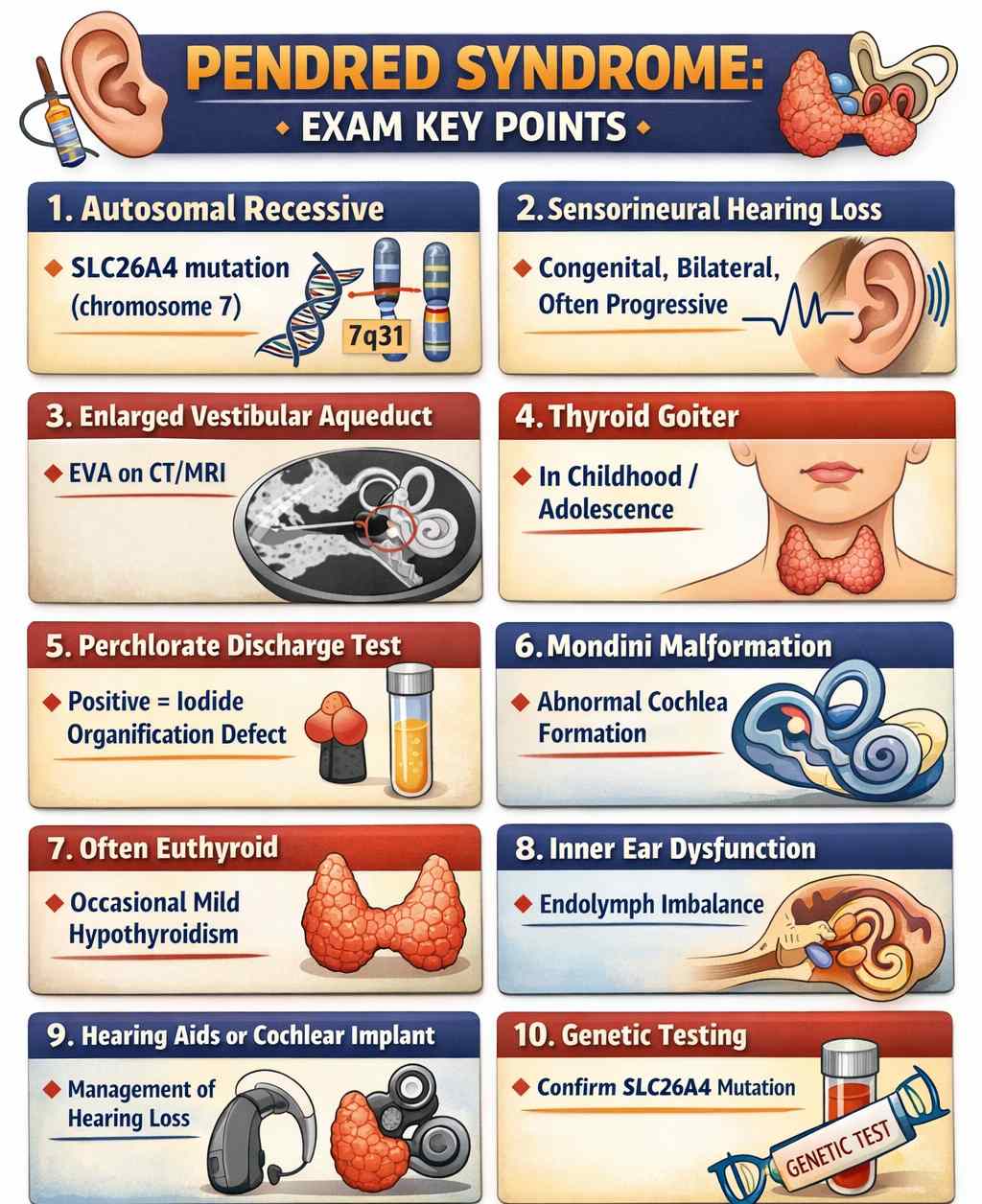
Pendred Syndrome
Pendred syndrome is an autosomal recessive disorder characterized by:
- Sensorineural hearing loss (SNHL)
- Thyroid goiter
- Defect in iodide organification
It is one of the most common forms of syndromic hereditary deafness.
1️⃣ Genetic Basis
- Caused by mutation in SLC26A4 gene
- Encodes pendrin, a chloride–iodide transporter
- Located on chromosome 7q31
Pendrin is expressed in:
- Inner ear (endolymph regulation)
- Thyroid (iodide transport)
- Kidney
2️⃣ Pathophysiology
🔹 Inner Ear
- Defective ion transport → abnormal endolymph homeostasis
- Leads to:
- Enlarged vestibular aqueduct (EVA)
- Mondini malformation (incomplete cochlear partition)
- Progressive or fluctuating SNHL
🔹 Thyroid
- Impaired iodide transport into follicular cells
- Results in:
- Defective organification
- Goiter (usually develops in adolescence)
- Often euthyroid or mild hypothyroidism
3️⃣ Clinical Features
| Feature | Description |
|---|---|
| Hearing loss | Congenital, bilateral, sensorineural |
| Progression | Often progressive or fluctuating |
| Goiter | Appears in childhood/adolescence |
| Thyroid function | Usually normal or mild hypothyroidism |
4️⃣ Key Diagnostic Clues
✅ Imaging
- CT/MRI temporal bone:
- Enlarged vestibular aqueduct (EVA) – hallmark
✅ Perchlorate discharge test
- Positive (iodide organification defect)
✅ Genetic testing
- SLC26A4 mutation confirmation
5️⃣ Differential Diagnosis
- Usher syndrome – hearing loss + retinitis pigmentosa
- Waardenburg syndrome – hearing loss + pigment abnormalities
- Alport syndrome – hearing loss + renal disease
6️⃣ Management
Hearing Loss
- Hearing aids
- Cochlear implant (if severe)
Thyroid
- Monitor TSH
- Levothyroxine if hypothyroid
- Surgery if large goiter
Genetic counseling
- Autosomal recessive inheritance
- 25% recurrence risk in siblings
🔥 High-Yield Exam Points
- Most common syndromic cause of congenital deafness
- EVA on imaging = strong clue
- Positive perchlorate test
- AR inheritance
- Hearing loss precedes goiter