ALL of the following exhibits Macewen sign EXCEPT?
A. Hydrocephalus
B. Brain abscesses
C. Raised intracranial tension
D. Meningitis
ANSWER
D. Meningitis do not show
Macewen sign seen in – A. Hydrocephalus B. Brain abscesses C. Raised intracranial tension
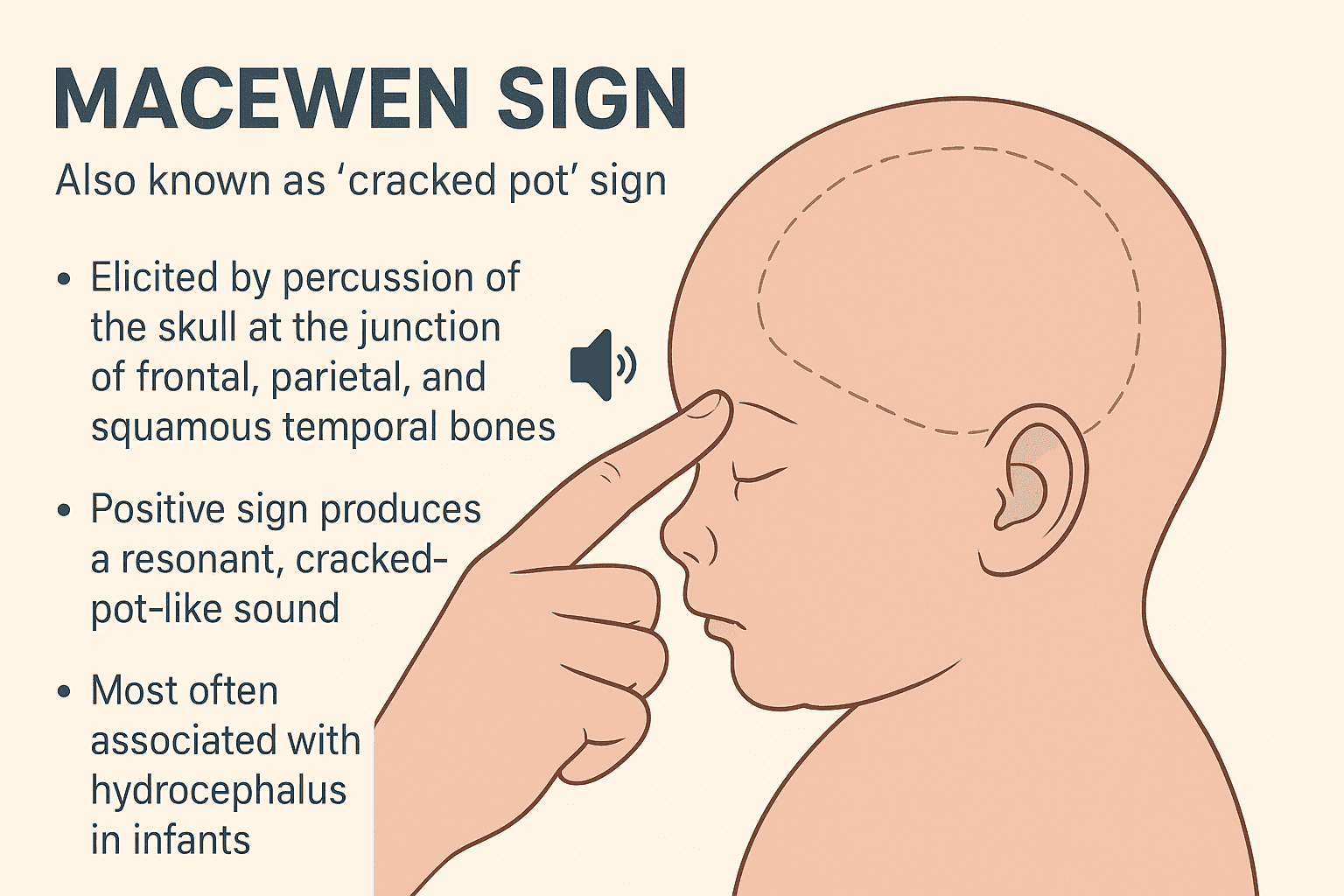
Tapping (percussion) the skull near the junction of the frontal, temporal, and parietal bones will produce cracked pot sound. Positive test is indication of separated sutures. This is due to raised intracranial tension
McEwan’s sign in alcohol intoxication is suggestive of –
A. B12 Deficiency related neurological sign
B. Associated Head injury
C. Alcoholic coma
D. Hepatic Encephalopathy
ANSWER
ANSWER – C. Alcoholic coma
‘Cracked pot sound’ on percussing the skull is seen in –
A. Meningitis
B. Hydrocephalus
C. Cerebral Palsy
D. Cerebellar infarct
ANSWER
ANSWER – B. Hydrocephalus cracked pot sign- sign to detect hydrocephalus and brain abscess. Percussion on the skull at a particular spot (near the junction of the frontal, temporal and parietal bones) produces resonant sound as produced by ‘cracked pot’ in the presence of hydrocephalus or a brain abscess called as cracked pot sign.
Macewen Sign – also called the “cracked pot sign” – is a clinical percussion sign seen in conditions where intracranial pressure or fluid accumulation causes separation of cranial sutures.
1. What is the Macewen sign primarily used to detect?
Pulmonary edema
Increased intracranial pressure due to hydrocephalus
Meningitis
Cerebral infarction
Macewen sign is elicited by percussion over the skull; a cracked-pot sound suggests hydrocephalus or raised intracranial pressure in infants.
2. In which age group is the Macewen sign most commonly elicited?
Adults
Infants and young children
Elderly patients
Adolescents
It is primarily used in infants and young children before the cranial sutures have fully fused.
3. What physical finding characterizes a positive Macewen sign?
Cracked-pot (ping) sound on percussion
Hyperresonant lung fields
Dullness over temporal bone
Clicking sound over sinuses
A positive sign produces a cracked-pot sound when percussing the skull, indicating increased intracranial pressure or separation of sutures.
4. Which clinical condition is most often associated with a positive Macewen sign?
Subdural hematoma
Hydrocephalus
Sinusitis
Otitis media
Hydrocephalus leads to separation of cranial sutures, allowing the cracked-pot resonance to be elicited.
5. The Macewen sign is best elicited by percussing over which part of the skull?
Junction of the frontal, parietal, and temporal bones
Occipital bone
Maxillary bone
Mandible
The sign is typically assessed at the junction where the three skull bones meet, near the anterior fontanelle in infants.
6. Which diagnostic tool has largely replaced the Macewen sign in modern practice?
Fundoscopy
Neuroimaging (CT/MRI)
Lumbar puncture
EEG
While Macewen sign can still be used clinically, neuroimaging provides definitive diagnosis for intracranial pathology.
7. The “cracked-pot” sound in Macewen sign occurs due to:
Excess bone density
Middle ear effusion
Separation of cranial sutures with underlying fluid
Air in the subdural space
The sound results from vibration over separated sutures with increased fluid pressure beneath.
8. Which historical context saw common use of Macewen sign?
Pre-imaging era pediatric neurology
Post-MRI modern diagnostics
Only veterinary medicine
Sports medicine
Before CT and MRI were available, bedside signs like Macewen sign were vital for diagnosing hydrocephalus.
9. A positive Macewen sign in an infant warrants which next step?
Immediate lumbar puncture
Neuroimaging to confirm cause
Observation only
Sinus X-ray
Confirming the diagnosis with imaging is essential before deciding on surgical or medical intervention.
10. Who first described the Macewen sign?
Harvey Cushing
Thomas Willis
Sir William Macewen
Jean Charcot
Sir William Macewen, a Scottish surgeon, described this clinical sign in the late 19th century.
11. Macewen sign is absent when:
Sutures are widely open
Sutures are completely fused
Fontanelle is bulging
There is CSF accumulation
Once sutures are fully fused, resonance is lost, and the sign cannot be elicited.
12. Which skull feature is most relevant to eliciting the Macewen sign?
Temporal muscle
Zygomatic arch
Cranial sutures
Occipital protuberance
The sign relies on the resonance created by fluid pressure separating cranial sutures.
13. Macewen sign is an example of which type of clinical sign?
Reflex sign
Vital sign
Percussion sign
Auscultatory sign
It is a percussion sign, as it is elicited by tapping on the skull.
14. In hydrocephalus, which mechanism causes a positive Macewen sign?
Increased blood flow
Calcification of sutures
Accumulation of cerebrospinal fluid
Enlargement of venous sinuses
CSF buildup leads to ventricular enlargement and separation of cranial sutures.
15. Which other condition, apart from hydrocephalus, can rarely cause Macewen sign?
Brain abscess
Otitis externa
Glaucoma
Epilepsy
A large brain abscess causing mass effect can sometimes produce this sign.
16. Which instrument is used to elicit Macewen sign?
Reflex hammer
Percussion with fingers
Tuning fork
Stethoscope
The sign is elicited by tapping the skull lightly with fingers.
17. In what type of hydrocephalus is Macewen sign more likely?
Communicating hydrocephalus
Non-communicating hydrocephalus only
Normal pressure hydrocephalus
All equally likely
Communicating hydrocephalus in infants causes generalized ventricular enlargement, producing the sign.
18. Why is Macewen sign not reliable in older children?
Cranial sutures have fused
CSF production decreases
Brain shrinkage
Increased scalp thickness
Fusion of sutures prevents the cracked-pot resonance from being elicited.
19. The “cracked-pot” resonance is acoustically similar to tapping on:
A metal bowl
An empty clay pot
A wooden board
A drum
The sound is reminiscent of tapping an empty clay pot — hence the name.
20. Which field of medicine historically emphasized Macewen sign?
Pediatric neurosurgery
Dermatology
Cardiology
Orthopedics
It was historically important in pediatric neurosurgery and neurology before modern imaging.
Key Details
Feature
Description
Definition
A hollow, resonant, “cracked pot” sound heard on percussing the skull.
Cause
Separation of cranial sutures due to increased intracranial pressure or hydrocephalus.
Mechanism
The widened sutures allow vibration of the skull bones, producing a characteristic note.
Common in
Infants (because sutures are not fused), hydrocephalus, brain abscess, or space-occupying lesions.
Elicitation
Percussion of the skull (usually over the frontal or parietal bones) with a fingertip.
Clinical relevance
Suggests raised intracranial pressure and warrants urgent evaluation.
💡 Mnemonic: “Macewen = ‘Mac cracked pot’” → Think of a hollow pot sound when tapped.
1. Macewen sign is also known as:
A. Silver fork sign
B. Cracked pot sign
C. Battle sign
D. Gowers sign
The Macewen sign is called the “cracked pot sign” because percussion over the skull produces a sound resembling that of a cracked pot.
2. Macewen sign is most often elicited in:
A. Skull fracture
B. Meningitis
C. Hydrocephalus
D. Otitis media
Hydrocephalus causes separation of cranial sutures in infants, producing the resonant percussion note characteristic of Macewen sign.
3. Which age group is Macewen sign most relevant for?
A. Adults
B. Elderly
C. Teenagers
D. Infants
The sign is primarily seen in infants due to unfused cranial sutures, which can separate under raised intracranial pressure.
4. The sound in Macewen sign is best described as:
A. Hollow and resonant
B. Dull
C. Metallic
D. Clicking
The sound is hollow and resonant, similar to tapping on a cracked pot, due to fluid and suture separation.
5. Which pathology other than hydrocephalus can produce Macewen sign?
A. Migraine
B. Brain abscess
C. Epilepsy
D. Sinusitis
Space-occupying lesions like brain abscess can cause increased intracranial pressure, leading to a positive Macewen sign.
6. Macewen sign is primarily used to detect which condition?
A. Pneumothorax
B. Hydrocephalus
C. Pleural effusion
D. Meningitis
Macewen sign, also known as the “cracked pot” sound, is a clinical indicator of hydrocephalus or brain abscess, especially in infants with open fontanelles.
7. The “cracked pot” sound in Macewen sign is heard during:
A. Auscultation
B. Palpation
C. Percussion
D. Inspection
The sign is elicited by percussion over the skull, producing a resonant, cracked pot-like sound.
8. Macewen sign is most reliable in which age group?
A. Adults
B. Infants
C. Teenagers
D. Elderly
It is most useful in infants because their cranial sutures and fontanelles are still open.
9. The pathophysiological basis of Macewen sign is:
A. Separation of cranial sutures due to increased intracranial pressure
B. Calcification of sutures
C. Thickening of meninges
D. Brain atrophy
Increased intracranial pressure causes suture separation, altering resonance and producing the characteristic percussion note.
10. Macewen sign can be positive in:
A. Chronic sinusitis
B. Skull fractures
C. Brain abscess
D. Subdural hematoma
It is seen in conditions like brain abscess, where localized pressure leads to suture separation.
Macewen sign- Question
Answer
What is Macewen sign also called?
“Cracked pot” sign
Who described Macewen sign?
Sir William Macewen
What causes Macewen sign in children?
Separation of cranial sutures due to raised intracranial pressure
What condition is it most commonly associated with in infants?
Hydrocephalus
How is Macewen sign elicited?
Percussion of the skull over junction of frontal, parietal, and temporal bones
What sound is heard in a positive Macewen sign?
Resonant “cracked pot” sound
In which age group is it most commonly elicitable?
Infants and young children
Why does the sign disappear as the child grows?
Cranial sutures close and ossify
Can Macewen sign be found in adults?
Rarely, only with conditions like large skull defects
Is Macewen sign specific for hydrocephalus?
No, it indicates increased intracranial pressure from various causes
Which imaging is preferred to confirm hydrocephalus?