DAPT Score
DAPT score
DAPT Score
1. Purpose of the DAPT Score
- Risk stratification tool to balance:
- Ischemic risk (risk of stent thrombosis, MI)
- Bleeding risk (risk of major bleeding)
- Helps clinicians decide whether to extend DAPT beyond 12 months after PCI.
2. Population
- Patients 12 months post-PCI with a drug-eluting stent (DES).
- Excludes patients with major bleeding complications during the first year.
3. Scoring System
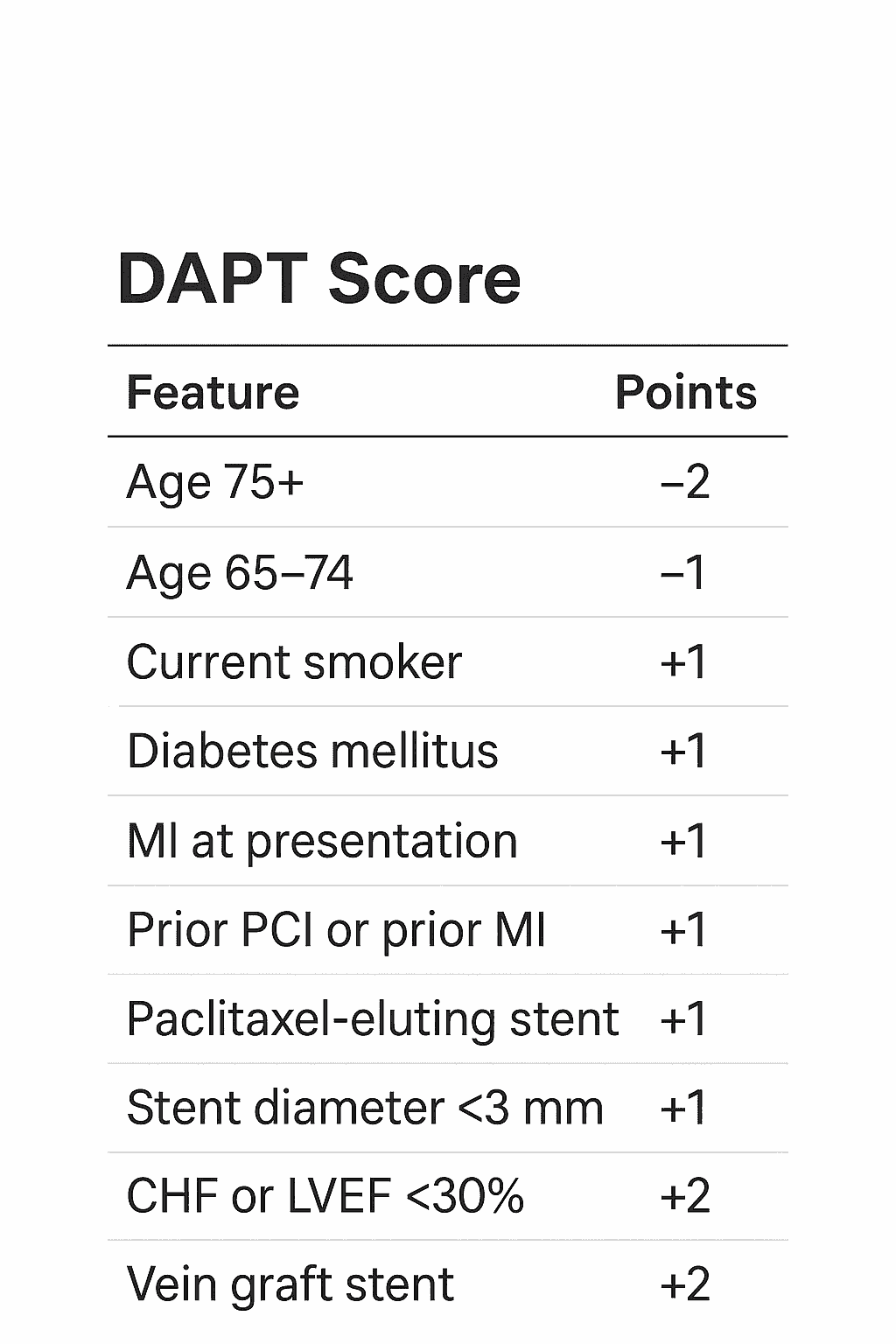
The DAPT score assigns points based on clinical and procedural characteristics:
| Feature | Points |
|---|---|
| Age 75+ | -2 |
| Age 65–74 | -1 |
| Current smoker | +1 |
| Diabetes mellitus | +1 |
| MI at presentation | +1 |
| Prior PCI or prior MI | +1 |
| Paclitaxel-eluting stent | +1 |
| Stent diameter <3 mm | +1 |
| CHF or LVEF <30% | +2 |
| Vein graft stent | +2 |
- Maximum score: +10
- Minimum score: -2
4. Interpretation
- DAPT score ≥2:
- High ischemic risk / low bleeding risk → Consider extending DAPT beyond 12 months.
- DAPT score <2:
- Higher bleeding risk / lower ischemic risk → Consider stopping DAPT at 12 months.
5. Key Notes
- Useful primarily for stable patients and post-PCI DES.
- Not validated for patients with prior major bleeding, atrial fibrillation requiring anticoagulation, or recent stroke.
- Should always be combined with clinical judgment, especially for bleeding risk assessment.
1. What is the DAPT score used for?
The DAPT score helps identify patients who benefit from prolonged dual antiplatelet therapy versus those at higher bleeding risk.
2. How many points does age ≥75 contribute to the DAPT score?
Patients ≥75 years are assigned -2 points, reflecting higher bleeding risk.
3. Which of the following adds +2 points to the DAPT score?
CHF or LVEF <30% adds +2 points, indicating higher ischemic risk.
4. Prior MI or PCI contributes how many points?
Prior MI or PCI adds +1 point to the DAPT score.
5. Which stent type contributes +1 point in the DAPT score?
Paclitaxel-eluting stent adds +1 point due to higher thrombotic risk.
6. Age 65–74 contributes how many points?
Age 65–74 is assigned -1 point, reflecting moderate bleeding risk.
7. Current smoking status contributes how many points?
Current smoker is assigned +1 point due to higher ischemic risk.
8. Which of the following increases the DAPT score by +1?
MI at presentation contributes +1 point.
9. Which feature does NOT increase the DAPT score?
Age ≥75 actually reduces the score by -2 points.
10. Small stent diameter (<3 mm) contributes how many points?
Stent diameter <3 mm is +1 point, reflecting higher thrombosis risk.
11. Diabetes mellitus contributes how many points?
Diabetes is +1 point due to higher ischemic risk.
12. Vein graft stent contributes how many points?
Vein graft stent contributes +2 points for increased ischemic risk.
13. CHF or LVEF <30% is considered:
CHF or LVEF <30% = +2 points in DAPT score.
14. The maximum positive DAPT score can be roughly:
Maximum score ≈ +7 if all positive predictors are present.
15. Negative points in DAPT score reflect:
Negative points, e.g., age ≥75, reflect higher bleeding risk.
16. MI at presentation contributes how many points?
MI at presentation adds +1 point.
17. Which combination increases ischemic risk the most in DAPT score?
CHF + vein graft stent gives +4 points, high ischemic risk.
18. A negative DAPT score suggests:
Negative DAPT score favors shorter DAPT due to bleeding risk.
19. Which of the following is NOT part of the DAPT score?
Hyperlipidemia is not included in the DAPT score.
20. The DAPT score helps clinicians balance:
DAPT score balances ischemic and bleeding risk to guide therapy duration.