Austin Flint Murmur
Austin Flint Murmur
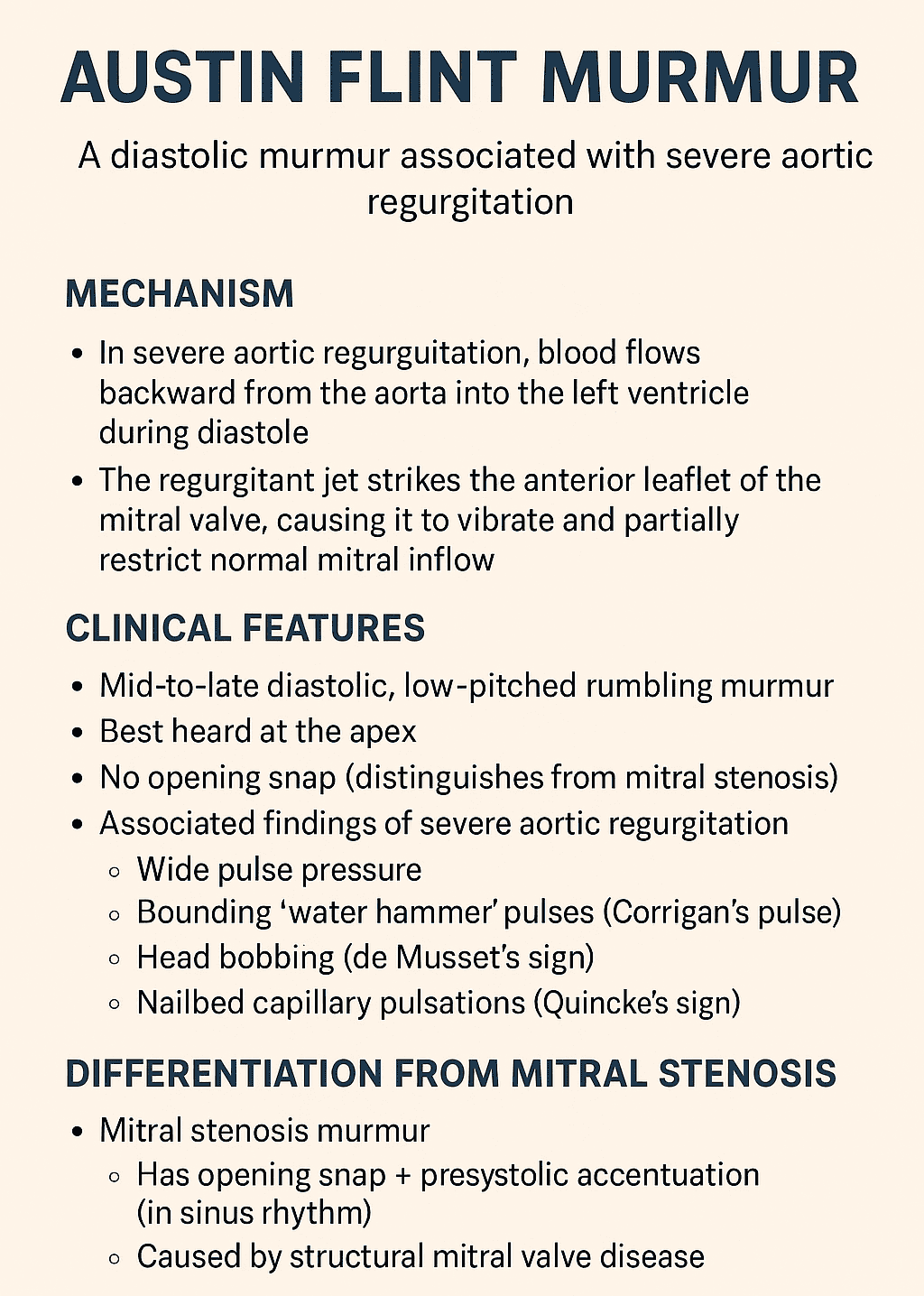
Austin Flint Murmur
The Austin Flint murmur is a diastolic murmur associated with severe aortic regurgitation (AR). It is named after the American physician Austin Flint, who first described it in 1862.
🔹 Mechanism
- In severe aortic regurgitation, blood flows backward from the aorta into the left ventricle (LV) during diastole.
- The regurgitant jet strikes the anterior leaflet of the mitral valve, causing it to vibrate and partially restrict normal mitral inflow.
- This creates a functional mitral stenosis–like murmur, even though the mitral valve is structurally normal.
🔹 Clinical Features
- Type: Mid-to-late diastolic, low-pitched rumbling murmur.
- Best heard at: The apex (similar location to mitral stenosis murmur).
- No opening snap (distinguishes from mitral stenosis).
- Associated findings of severe AR:
- Wide pulse pressure
- Bounding “water hammer” pulses (Corrigan’s pulse)
- Head bobbing (de Musset’s sign)
- Nailbed capillary pulsations (Quincke’s sign)
🔹 Differential Diagnosis
- Mitral stenosis murmur
- Has opening snap + presystolic accentuation (in sinus rhythm).
- Caused by structural mitral valve disease.
- Austin Flint murmur
- No opening snap, no loud S1.
- Caused by functional mitral valve obstruction due to regurgitant jet.
🔹 Clinical Importance
- Presence of an Austin Flint murmur indicates severe aortic regurgitation and usually suggests the need for surgical evaluation (valve replacement/repair).
The Austin Flint murmur is
a low-pitched, mid-to-late diastolic rumbling heart murmur heard at the apex (bottom) of the heart. It is associated with severe aortic regurgitation, where blood flows backward into the left ventricle, and is not caused by any abnormality of the mitral valve itself.
Mechanism
While the exact mechanism is debated, the leading theory is that the murmur is caused by the regurgitant jet of blood from the aorta striking the inner wall of the left ventricle. This creates turbulence and vibrations that generate the rumbling sound. Some evidence suggests this jet also vibrates the anterior leaflet of the mitral valve, which can cause its premature closure during diastole.
Symptoms and physical findings
The Austin Flint murmur itself is not a symptom, but it indicates a diagnosis of severe aortic regurgitation. The murmur’s characteristics may be heard during a physical examination, but additional signs of severe aortic regurgitation are usually present:
- Aortic insufficiency murmur: A separate, high-pitched, blowing diastolic murmur heard best at the left sternal border.
- Widened pulse pressure: The difference between systolic and diastolic blood pressure is large due to the backflow of blood during diastole.
- “Water hammer” pulse: A strong, brisk pulse that collapses suddenly during diastole.
Austin Flint murmur vs. mitral stenosis
The Austin Flint murmur is clinically significant because its characteristics mimic those of mitral stenosis, a different heart valve condition. The following table shows how a doctor can differentiate between the two conditions.
| Feature | Austin Flint Murmur | Mitral Stenosis Murmur |
|---|---|---|
| Primary Condition | Severe aortic regurgitation. | Mitral valve narrowing. |
| Mitral Valve | Anatomically normal. | Abnormally narrow. |
| Opening Snap | Absent, since there is no structural mitral valve disease. | Present, as the stiff mitral valve opens. |
| Loudness of S1 | Usually normal. | A loud S1 heart sound. |
| Response to Amyl Nitrite | Decreases in intensity due to a drop in afterload. | Increases in intensity and duration as heart rate rises. |
Diagnosis and management
An audible Austin Flint murmur is a sign of advanced aortic regurgitation that requires further investigation.
- Diagnosis: The presence of the murmur is confirmed using a transthoracic Doppler echocardiogram, which visualizes the heart’s structure and blood flow.
- Management: Treatment is focused on the underlying severe aortic regurgitation and may include regular monitoring or surgical valve replacement, depending on the severity and presence of other symptoms.