Fractional Flow Reserve
Fractional Flow Reserve (FFR)
Fractional Flow Reserve (FFR) is an invasive physiologic index used in coronary angiography to determine whether a coronary artery stenosis is hemodynamically significant and causing myocardial ischemia.
Definition
FFR = Maximum blood flow in a stenotic coronary artery ÷ Maximum blood flow if the artery were normal
Clinically measured as:FFR=PaPd
Where
- Pd = distal coronary pressure (beyond the stenosis)
- Pa = aortic pressure (proximal pressure)
Measured during maximal hyperemia (usually induced with adenosine).
Principle
During maximal hyperemia, microvascular resistance becomes minimal and constant, so pressure becomes proportional to flow.
Therefore pressure ratio reflects flow limitation caused by the stenosis.
Normal Value
- Normal coronary artery: FFR ≈ 1.0
Clinical Cut-offs
| FFR value | Interpretation | Management |
|---|---|---|
| >0.80 | Not ischemia producing | Medical therapy |
| ≤0.80 | Hemodynamically significant stenosis | Revascularization (PCI/CABG) |
| ≤0.75 | Almost always ischemia | Strong indication for revascularization |
(Modern guideline threshold: 0.80)
How FFR is Measured (Cath Lab Steps)
- Coronary artery engaged with guiding catheter
- Pressure wire advanced distal to stenosis
- Baseline Pa and Pd recorded
- Maximal hyperemia induced
- IV adenosine: 140 µg/kg/min (standard)
- Intracoronary adenosine alternative
- Lowest Pd/Pa ratio recorded as FFR
Drugs Used for Hyperemia
- Adenosine (gold standard)
- Papaverine
- Regadenoson
- ATP
Major Clinical Uses
- Intermediate coronary stenosis (40–70%)
- Multivessel CAD – culprit lesion identification
- Left main stenosis assessment
- Post-PCI optimization
- Guiding revascularization decisions
Situations Where FFR is Less Reliable
- Acute STEMI culprit vessel
- Severe microvascular dysfunction
- Severe LV hypertrophy
- Inadequate hyperemia
Key Clinical Trials
- FAME Trial
- FFR-guided PCI ↓ death, MI, repeat revascularization.
- FAME 2 Trial
- PCI beneficial when FFR ≤0.80.
- DEFER Trial
- Lesions with FFR >0.75 safe to defer PCI.
FFR vs iFR
| Feature | FFR | iFR |
|---|---|---|
| Hyperemia | Required | Not required |
| Measurement | During maximal vasodilation | Diastolic wave-free period |
| Cut-off | ≤0.80 | ≤0.89 |
| Drug needed | Adenosine | None |
NEET-SS / Cardiology Exam Pearls
- Gold standard physiologic index for ischemia-producing coronary stenosis.
- Measured during maximal hyperemia.
- FFR ≤0.80 → revascularization recommended.
- Pressure wire technology introduced in 1990s.
- Less affected by heart rate or blood pressure.
- Useful in angiographically intermediate lesions.
- Improves outcomes when guiding PCI.
- iFR developed to avoid adenosine use.
1. Fractional Flow Reserve (FFR) is defined as:
FFR represents maximal achievable blood flow in diseased artery relative to normal artery.
2. Clinically FFR is calculated as:
FFR = distal coronary pressure (Pd) divided by aortic pressure (Pa) during maximal hyperemia.
3. Hyperemia during FFR measurement is most commonly induced by:
IV adenosine infusion (140 µg/kg/min) is the standard drug used to achieve maximal hyperemia.
4. Current guideline threshold for ischemia-producing stenosis is:
FFR ≤0.80 indicates hemodynamically significant stenosis requiring revascularization.
5. Normal FFR in a healthy coronary artery is approximately:
Normal coronary arteries have FFR very close to 1.0.
6. Which vessel measurement is required for FFR?
A pressure wire measures distal coronary pressure beyond the stenosis.
7. Major advantage of FFR-guided PCI demonstrated in the
FAME trial showed improved outcomes with FFR-guided PCI.
8. The concept of FFR assumes microvascular resistance during hyperemia is:
Hyperemia minimizes microvascular resistance, making pressure proportional to flow.
9. FFR is most useful in evaluating:
Best application is angiographic stenosis 40–70%.
10. Intravenous adenosine dose used for FFR hyperemia:
Standard IV adenosine infusion is 140 µg/kg/min.
11. Which of the following best describes the physiologic basis of FFR?
During maximal hyperemia, microvascular resistance becomes minimal and stable, so pressure ratio reflects coronary flow.
12. Which index measures coronary physiology without inducing hyperemia?
iFR is measured during the diastolic wave-free period and does not require adenosine.
13. The commonly accepted ischemic threshold for iFR is:
For iFR, the accepted threshold for ischemia is ≤0.89.
14. Which coronary lesion is particularly suitable for FFR assessment?
FFR is most useful in angiographically intermediate lesions.
15. Which trial showed that PCI can be safely deferred when FFR >0.75?
The DEFER trial demonstrated that PCI can be safely deferred when FFR is above ischemic threshold.
16. Which artery pressure is used as the proximal reference in FFR?
Aortic pressure (Pa) is used as the proximal pressure reference.
17. Which condition can reduce reliability of FFR measurement?
Microvascular disease can impair hyperemic response, affecting FFR accuracy.
18. Which coronary physiology index reflects both epicardial and microvascular function?
CFR reflects both epicardial stenosis and microvascular resistance.
19. FFR value of 0.60 indicates:
FFR far below 0.80 indicates significant ischemia-producing stenosis.
20. FFR pullback technique is mainly used to evaluate:
Pullback helps identify pressure drops across multiple lesions.
21. Which physiologic parameter does FFR primarily assess?
FFR determines the functional significance of a coronary lesion.
22. FFR measurement requires which device?
A pressure-sensing coronary guidewire is used.
23. Which coronary territory is most frequently studied with FFR?
LAD intermediate lesions are the most commonly assessed.
24. Which modality provides anatomical rather than physiological assessment?
IVUS provides anatomical imaging of plaque and lumen.
25. FFR measurement is least reliable in:
Microvascular dysfunction during STEMI may affect FFR accuracy.
26. A coronary lesion with FFR 0.85 should generally be:
FFR above 0.80 indicates non-ischemic stenosis.
27. Which physiological variable does NOT significantly influence FFR?
FFR remains relatively independent of systemic hemodynamic variations.
28. Which imaging modality is often combined with FFR to guide PCI?
FFR (physiology) combined with IVUS/OCT (anatomy) optimizes PCI.
29. The main advantage of FFR-guided PCI is:
FFR identifies lesions truly responsible for ischemia.
30. Which physiological phenomenon allows pressure to reflect coronary flow during FFR measurement?
Maximal hyperemia minimizes microvascular resistance, making pressure proportional to flow.
one-liners on Fractional Flow Reserve useful for NEET-SS / DM Cardiology exams:
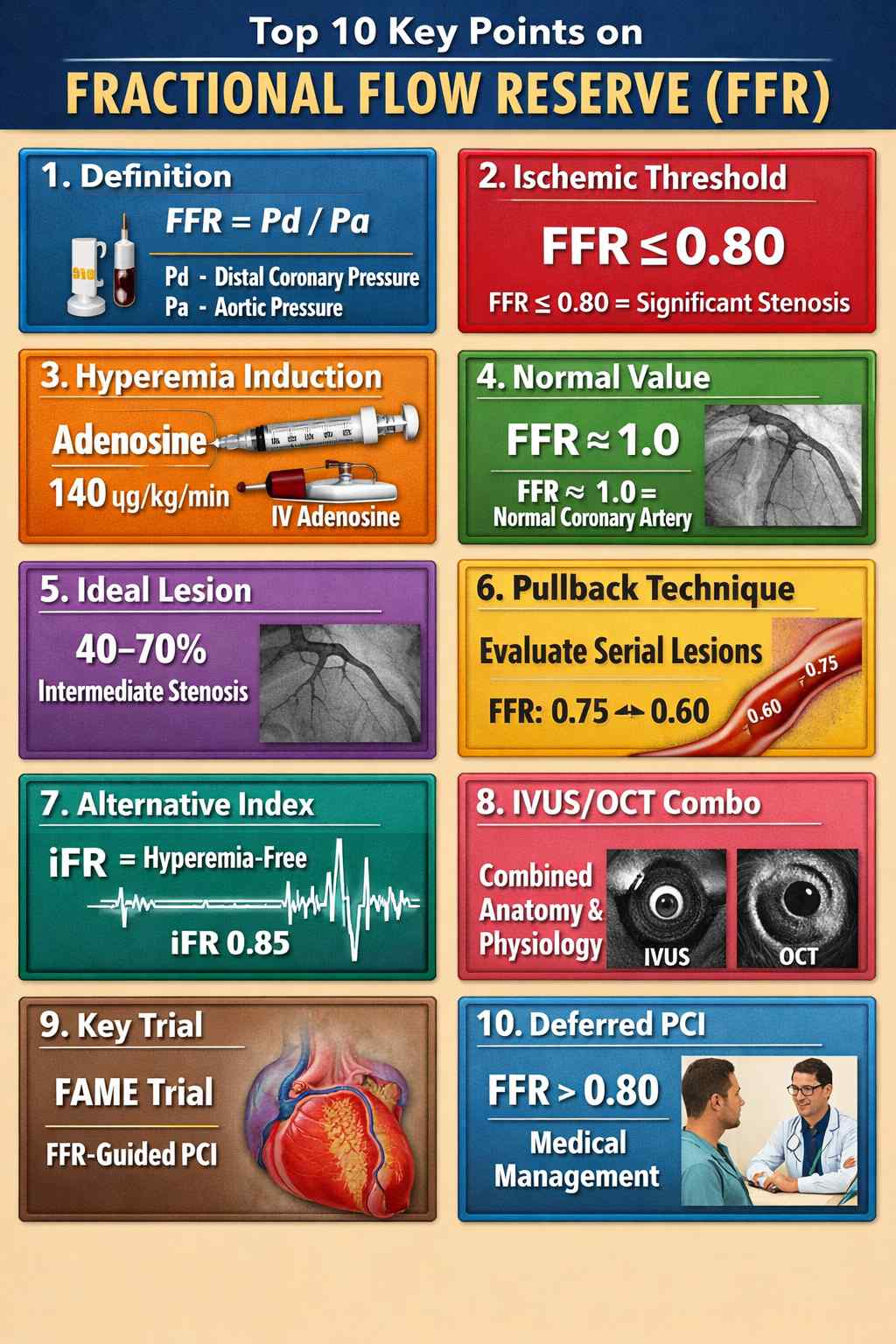
- FFR = Pd / Pa during maximal hyperemia, where Pd = distal coronary pressure and Pa = aortic pressure.
- Normal FFR ≈ 1.0, indicating no hemodynamically significant epicardial stenosis.
- FFR ≤ 0.80 defines ischemia-producing coronary stenosis and is the modern threshold for revascularization.
- Maximal hyperemia is usually induced by IV adenosine 140 µg/kg/min during FFR measurement.
- The physiologic principle of FFR depends on minimal and constant microvascular resistance during hyperemia.
- Intermediate coronary lesions (40–70% stenosis) are the classic indication for FFR assessment.
- The FAME Trial showed that FFR-guided PCI reduces death, MI, and repeat revascularization compared with angiography-guided PCI.
- DEFER Trial demonstrated that PCI can be safely deferred when FFR >0.75.
- FFR pullback recording helps differentiate diffuse disease from focal stenosis in serial lesions.
- Instantaneous Wave-Free Ratio (iFR) measures coronary physiology without adenosine, using the diastolic wave-free period with a cutoff ≤0.89.