Cauda equina lesion
Cauda equina lesion
A cauda equina lesion refers to pathology affecting the lumbosacral nerve roots (L2–S5) within the spinal canal below the termination of the spinal cord (conus medullaris).
It is a lower motor neuron (LMN) lesion and constitutes a neurosurgical emergency when presenting as cauda equina syndrome.
1️⃣ Anatomy Overview
- Spinal cord ends at L1–L2 vertebral level
- Below this → bundle of nerve roots = cauda equina
- Contains:
- Motor fibers (LMN)
- Sensory fibers
- Parasympathetic fibers (S2–S4 → bladder, bowel, sexual function)
2️⃣ Common Causes
Compressive
- Massive central lumbar disc herniation (L4–L5 most common)
- Lumbar canal stenosis
- Tumors (ependymoma, metastasis)
- Epidural abscess
- Epidural hematoma
- Trauma
Non-compressive
- Arachnoiditis
- Diabetic radiculopathy
- Inflammatory neuropathies
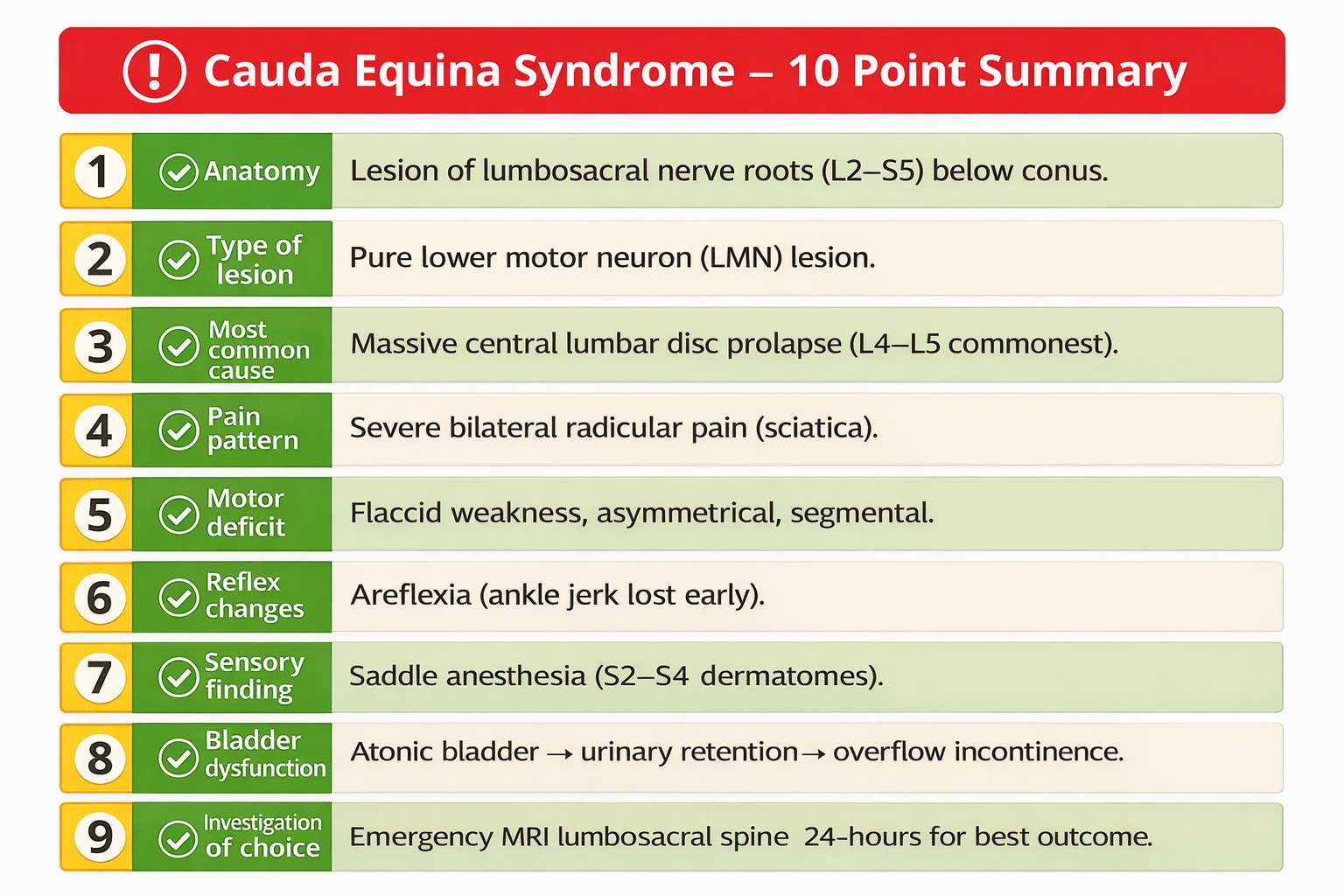
3️⃣ Clinical Features (Classic Cauda Equina Syndrome)
🟥 Motor (LMN pattern)
- Flaccid paralysis
- Areflexia
- Fasciculations (late)
- Asymmetric weakness
🟧 Sensory
- Saddle anesthesia (S2–S4 dermatomes)
- Patchy, radicular sensory loss
- Asymmetric distribution
🟨 Reflexes
- Absent ankle jerk
- Knee jerk may be affected (L3–L4)
🟩 Autonomic (Late but Critical)
- Urinary retention (most important early sign)
- Overflow incontinence
- Loss of anal tone
- Erectile dysfunction
4️⃣ Cauda Equina vs Conus Medullaris
| Feature | Cauda Equina | Conus Medullaris |
|---|---|---|
| Type | LMN | UMN + LMN |
| Onset | Gradual | Sudden |
| Symmetry | Asymmetric | Symmetric |
| Reflexes | Absent | May be preserved |
| Pain | Severe radicular pain | Mild pain |
| Bladder involvement | Late | Early |
5️⃣ Red Flag Clinical Scenario (NEET SS Favorite)
Bilateral sciatica + urinary retention + saddle anesthesia
→ Think Cauda Equina until proven otherwise
6️⃣ Investigation
- MRI lumbosacral spine – Gold standard
- Bladder scan (post-void residual)
- EMG (chronic cases)
7️⃣ Management
🚨 Emergency decompression within 24–48 hours
- Laminectomy + discectomy (if disc prolapse)
- Drain abscess / hematoma
- High-dose steroids (selected cases like tumor)
Delay → permanent bladder dysfunction.
8️⃣ Prognosis
- Best recovery if surgery < 24 hrs
- Bladder recovery poorest if retention > 48 hrs
- Motor recovery better than sphincter recovery
9️⃣ Key NEET SS Exam Pearls
✔ Areflexia confirms LMN lesion
✔ Saddle anesthesia = S2–S4 involvement
✔ Urinary retention = most sensitive early sign
✔ Severe radicular pain differentiates from conus
✔ Asymmetry strongly favors cauda equina
1. Earliest sensitive indicator of cauda equina syndrome?
A. Saddle anesthesia
B. Bilateral sciatica
C. Urinary retention with ↑ PVR
D. Loss of ankle jerk
Post-void residual >100–200 mL is the earliest reliable marker.
2. Massive central L4–L5 disc compresses mainly:
A. L4 root
B. Traversing L5 & sacral roots
C. Conus medullaris
D. Dorsal columns
Central herniation affects descending cauda roots (L5, S1 predominant).
3. Reflex pattern in pure cauda equina lesion:
A. Hyperreflexia
B. Clonus
C. Segmental areflexia
D. Babinski positive
It is a lower motor neuron lesion → hyporeflexia/areflexia.
4. Feature favoring cauda equina over conus lesion:
A. Early bladder involvement
B. Symmetric weakness
C. Bilateral Babinski
D. Severe radicular pain
Radicular pain & asymmetry favor cauda equina.
5. Saddle anesthesia corresponds to:
A. L1–L2
B. S2–S4
C. L5–S1
D. T12–L1
Perianal sensation mediated by S2–S4 roots.
6. Most common etiology overall:
A. Massive lumbar disc herniation
B. Multiple sclerosis
C. Syringomyelia
D. Vertebral artery infarct
Large central disc prolapse is the commonest cause.
7. Ankle jerk corresponds primarily to:
A. S1
B. L3
C. L1
D. T12
S1 root mediates Achilles reflex.
8. Gold standard diagnostic modality:
A. CT myelogram
B. X-ray spine
C. EMG
D. MRI lumbosacral spine
MRI visualizes compressive pathology and neural elements.
9. Bladder dysfunction mechanism:
A. UMN spastic bladder
B. Atonic LMN bladder
C. Detrusor hyperreflexia
D. Pontine lesion
S2–S4 parasympathetic loss → flaccid retention.
10. Ideal decompression timing for best recovery:
A. Within 24–48 hours
B. Within 7 days
C. After conservative therapy
D. Only if motor deficit worsens
Early decompression improves bladder outcome.
11. Bilateral extensor plantar response suggests:
A. Cauda equina
B. Peripheral neuropathy
C. Conus/cord involvement
D. Radiculopathy
Babinski = UMN sign → not pure cauda equina.
12. Sensory loss pattern is typically:
A. Hemisensory
B. Dissociated
C. Level-defined
D. Patchy radicular
Multiple root involvement → patchy dermatomal loss.
13. Most reliable bedside test for S2–S4 motor function?
A. Anal tone assessment
B. Plantar reflex
C. Knee jerk
D. Cremasteric reflex
Anal sphincter tone directly assesses S2–S4 integrity.
14. Overflow incontinence in cauda equina is due to:
A. Detrusor hyperreflexia
B. Atonic bladder with retention
C. Internal sphincter spasm
D. Pontine lesion
LMN bladder causes retention → overflow leakage.
15. Which tumor most classically causes cauda equina syndrome?
A. Meningioma
B. Astrocytoma
C. Hemangioblastoma
D. Myxopapillary ependymoma
Myxopapillary ependymoma commonly arises in filum terminale.
16. EMG finding in chronic cauda equina lesion:
A. Normal motor units
B. Myopathic potentials
C. Fibrillation potentials
D. Conduction block
Denervation produces fibrillations and positive sharp waves.
17. Erectile dysfunction occurs due to damage of:
A. Parasympathetic S2–S4 fibers
B. T12 sympathetic fibers
C. Pudendal sensory only
D. Femoral nerve
Erection mediated by parasympathetic S2–S4 roots.
18. Most common reflex lost first:
A. Knee jerk
B. Ankle jerk
C. Biceps reflex
D. Jaw jerk
S1 involvement → early loss of Achilles reflex.
19. Bilateral sciatica indicates involvement of:
A. Single nerve root
B. Conus only
C. Multiple lumbosacral roots
D. Dorsal columns
Sciatica bilaterally implies multi-root compression.
20. Most predictive factor for poor bladder recovery:
A. Age >60
B. Bilateral weakness
C. Saddle anesthesia duration
D. Retention >48 hours
Prolonged retention damages detrusor irreversibly.
21. Preferred surgical procedure in disc-related CES:
A. Laminectomy with discectomy
B. Spinal fusion only
C. Conservative therapy
D. Radiotherapy
Urgent decompression via laminectomy + disc removal.
22. Arachnoiditis-related CES typically shows:
A. Disc extrusion
B. Clumped nerve roots on MRI
C. Vertebral collapse
D. Syrinx formation
MRI shows nerve root clumping & empty thecal sac sign.
23. Sensory loss in CES spares:
A. Perianal region
B. Posterior thigh
C. Trunk above L1
D. Lateral foot
Lesion is below cord termination.
24. Most important immediate step after suspicion:
A. Start steroids
B. Bladder training
C. Physiotherapy
D. Emergency MRI
MRI confirmation guides urgent decompression.
25. Cauda equina lesion is anatomically:
A. Peripheral nerve root lesion
B. UMN lesion
C. Brainstem lesion
D. Cortical lesion
Roots are peripheral nervous system structures.
26. Typical motor pattern:
A. Spastic paralysis
B. Flaccid paralysis
C. Rigidity
D. Decorticate posture
LMN lesion → flaccidity & atrophy.
27. Most common dermatome involved in large L5–S1 disc:
A. L2
B. L3
C. S1
D. T12
S1 radiculopathy common in L5–S1 prolapse.
28. Loss of bulbocavernosus reflex indicates damage to:
A. L1
B. T12
C. L4
D. S2–S4
Bulbocavernosus reflex mediated by S2–S4.
29. Key differentiating feature from peripheral neuropathy:
A. Severe radicular back pain
B. Stocking-glove pattern
C. Symmetric distal loss
D. No sphincter involvement
Radicular pain with saddle anesthesia favors CES.
30. Best prognostic motor outcome is seen when:
A. Surgery delayed >72 hrs
B. Decompression done early
C. Only steroids used
D. Conservative care chosen
Early decompression yields best neurological recovery.