Baux score
Baux Score
What is the use of Baux score?
Baux score is a system used to predict the chance of mortality due to burns
Baux score is highly correlative with length of stay in hospital due to burns and final outcome.
What is original Baux score?
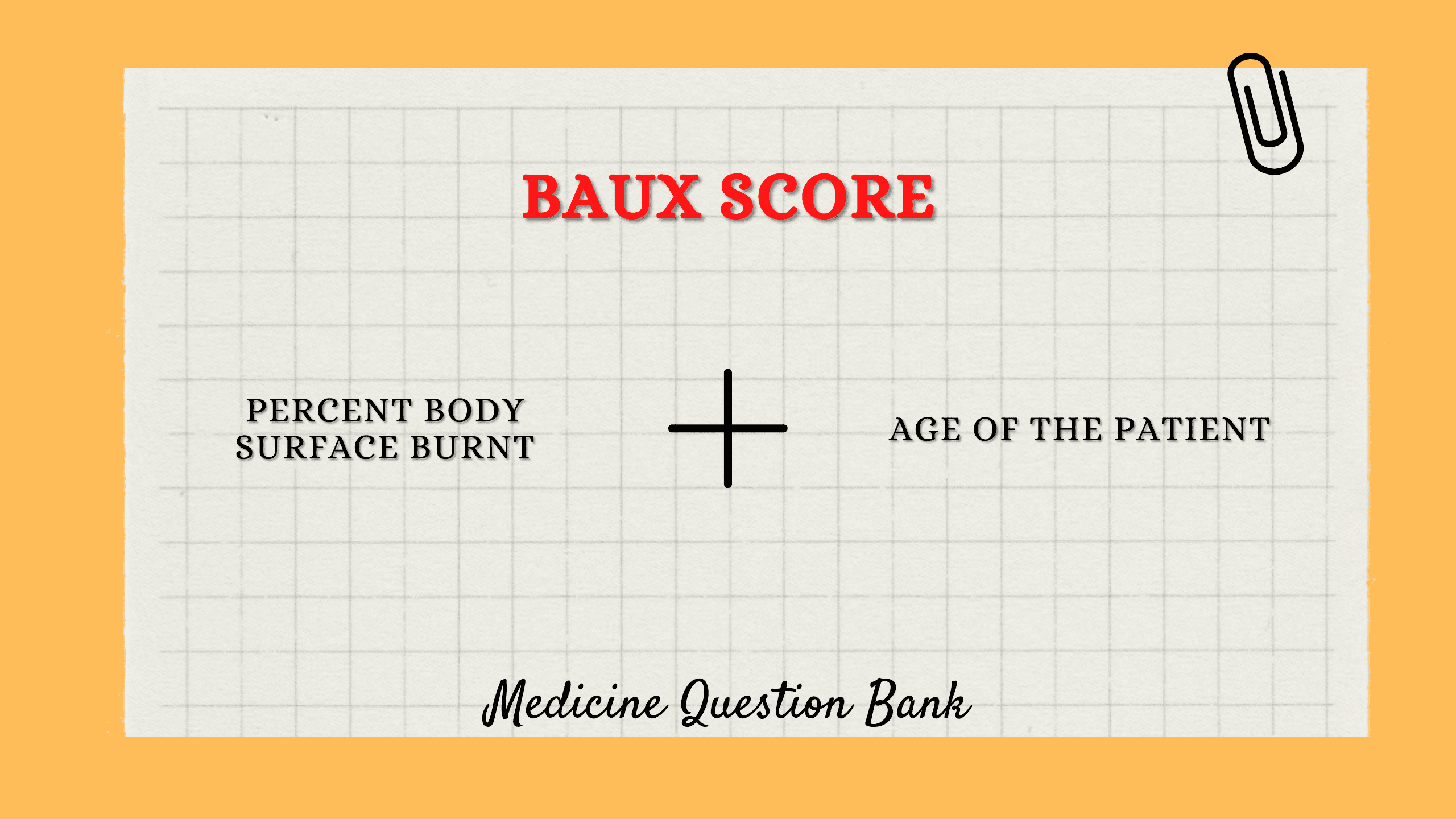
Baux score = Percent Body surface Burnt + age of the patient
score is a comparative indicator of burn severity, with a score over 140 considered as being unsurvivable
What is modified Baux score?
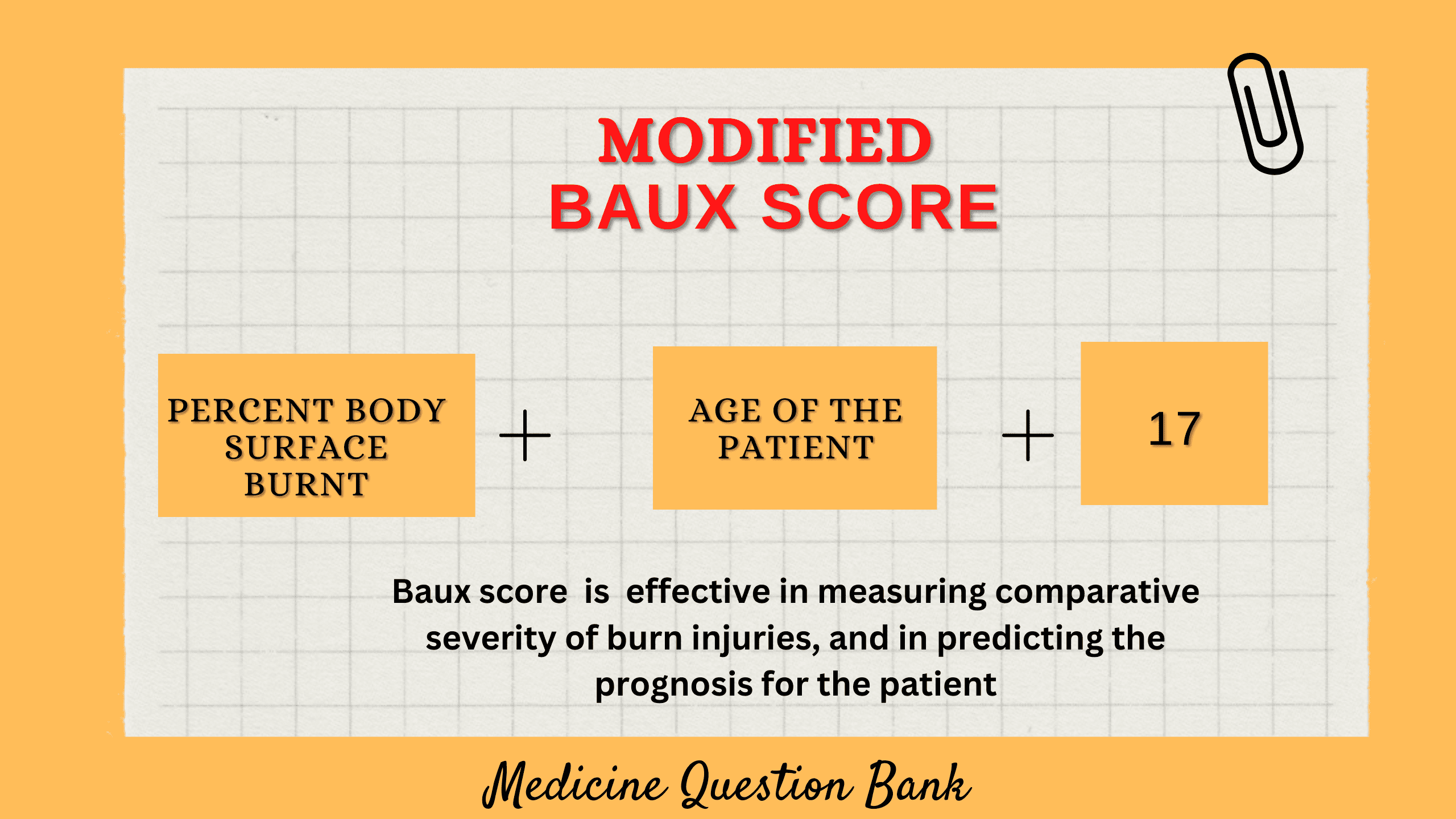
Patient with inhalation injury would have their score calculated by
Modified Baux score = Body area affected + age of patient + 17
| Component | Classic Baux Score | Revised Baux Score |
|---|---|---|
| Formula | Age + %TBSA burned | Age + %TBSA burned + 17 (if inhalation injury) |
| Interpretation | Score ≈ mortality % | More accurate, accounts for inhalation injury |
| Example | 40 yrs + 50% TBSA = 90 | 40 + 50 + 17 = 107 (with inhalation injury) |
| Clinical Use | Prognosis, mortality prediction, triage, outcome comparison in burn patients | |
🔹 Baux Score
Definition:
- The Baux score is a prognostic index used in burn patients to predict mortality risk.
- It combines age and burn size (Total Body Surface Area, TBSA%).
📊 Formula
- Classic Baux score = Age (years) + %TBSA burned
- Revised Baux score (r-Baux) = Age + %TBSA burned + 17 × (if inhalation injury present)
🔹 Interpretation
- The higher the score, the higher the mortality risk.
- Roughly:
- Baux score ≈ probability of death (%)
- e.g., Score 80 → ~80% predicted mortality.
- Revised Baux improves accuracy by including inhalation injury.
🔹 Clinical Use
- Guides prognosis & counseling in severe burns.
- Helps triage patients for ICU/burn center care.
- Useful for research & outcomes comparison.
🔹 Example
- A 40-year-old with 50% TBSA burns and inhalation injury →
- r-Baux = 40 + 50 + (17 × 1) = 107 → very high mortality risk.
👉 Mnemonic: “Age + Area = Baux; add smoke = revised Baux.”
1. What does the classic Baux score calculate?
The classic Baux score = Age + %TBSA burned.
2. What is added in the revised Baux score?
Revised Baux = Age + %TBSA + 17 if inhalation injury present.
3. A 30-year-old with 40% TBSA burns has a Baux score of?
Baux = Age (30) + TBSA (40) = 70.
4. Which patient has the highest predicted mortality by Baux?
Higher sum of age + TBSA = higher score → higher mortality.
5. If Baux score = 100, mortality risk is approximately?
Approximate mortality ≈ Baux score (%).
6. Who first described the Baux score?
The score was described by Baux in 1961 for burn mortality.
7. Revised Baux score for 40y, 50% TBSA, with inhalation injury?
40+50+17 = 107.
8. What is the primary purpose of Baux score?
It is a prognostic tool, not therapeutic.
9. Baux score is most accurate in which group?
It was developed mainly in adult populations.
10. What happens to accuracy of classic Baux score if inhalation injury present?
Classic score does not account for inhalation → revised score improves accuracy.
11. Baux score = 50. Approximate mortality?
Baux ≈ mortality percentage.
12. Inhalation injury adds how many points in revised Baux?
Revised Baux adds 17 points if inhalation injury.
13. 70y with 20% TBSA burn has Baux score?
70+20=90.
14. Which is NOT included in revised Baux?
Shock index not used in Baux score.
15. Who benefits most from revised Baux?
Revised score adjusts for inhalation injuries.
16. Baux score is primarily used in?
Exclusively for burn prognosis.
17. A 25y with 30% TBSA burn + inhalation injury → revised Baux?
25+30+17=72.
18. Classic Baux score excludes?
Classic formula = Age+TBSA only.
19. Which score is better for modern burn care?
Revised Baux correlates better with actual mortality.
20. Baux score is mainly useful for?
Its sole validated use is mortality prediction.