Arteria Lusoria
Arteria lusoria,
Arteria Lusoria
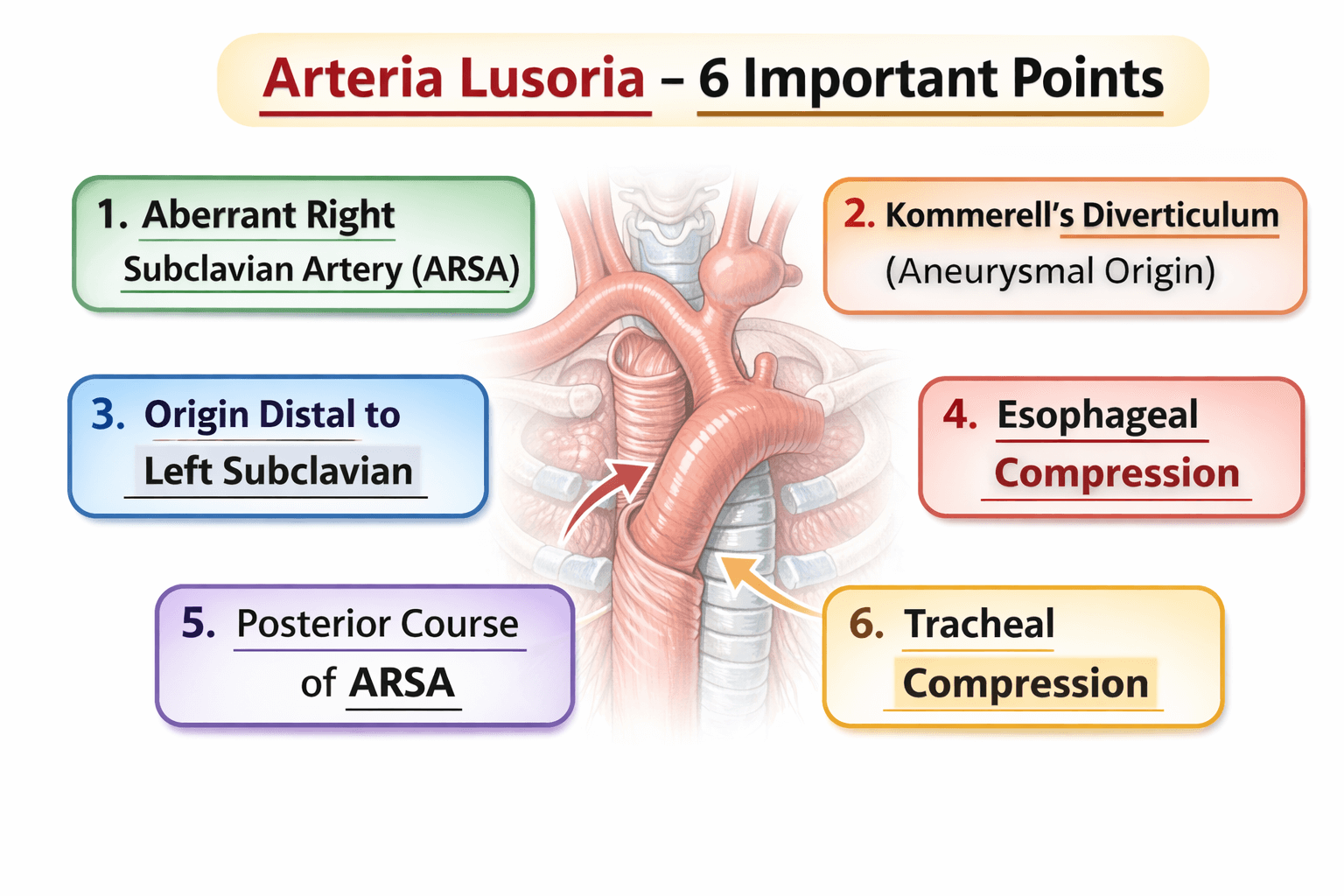
Arteria lusoria refers to an aberrant right subclavian artery (ARSA)—the most common congenital anomaly of the aortic arch.
1️⃣ Definition
It is a vascular anomaly in which the right subclavian artery arises as the last branch of the aortic arch, instead of from the brachiocephalic trunk, and typically courses posterior to the esophagus to reach the right upper limb.
2️⃣ Embryology
Normal development:
- Right 4th aortic arch → proximal right subclavian artery
- Right dorsal aorta regresses distally
In arteria lusoria:
- The right 4th arch regresses abnormally
- The right dorsal aorta persists
- Result → right subclavian arises distal to left subclavian
3️⃣ Anatomy
Normal aortic arch branches:
- Brachiocephalic trunk
- Left common carotid
- Left subclavian
In arteria lusoria:
- Left common carotid
- Left subclavian
- Aberrant right subclavian artery (last branch)
Course:
- 80% → posterior to esophagus
- 15% → between esophagus and trachea
- 5% → anterior to trachea
4️⃣ Clinical Significance
🔹 Dysphagia Lusoria
Compression of esophagus → progressive dysphagia
Term coined in 1794 by David Bayford
🔹 Respiratory symptoms (rare)
Stridor, cough (especially in infants)
🔹 Aneurysmal dilation
May form a Kommerell diverticulum
5️⃣ Associated Conditions
- Down syndrome
- DiGeorge syndrome
- Congenital heart disease
6️⃣ Diagnosis
Gold standard:
- CT angiography
Other modalities:
- Barium swallow → posterior indentation
- MRI angiography
- Doppler ultrasound
7️⃣ Management
Asymptomatic → Observation
Symptomatic:
- Surgical reimplantation to right carotid
- Endovascular repair if aneurysmal
8️⃣ Exam Pearls (NEET-SS / Superspeciality)
- Most common aortic arch anomaly
- Causes dysphagia without intrinsic esophageal disease
- Think of it in elderly patient with progressive dysphagia and normal endoscopy
- May be associated with Kommerell diverticulum aneurysm
Q1. Progressive dysphagia with normal endoscopy in elderly. Likely mechanism?
A. Extrinsic esophageal compression by aberrant artery
B. LES failure
C. Intrinsic mucosal lesion
D. Diffuse spasm
Dysphagia lusoria is due to external vascular compression.
Q2. Most common course of arteria lusoria?
A. Anterior to trachea
B. Posterior to esophagus
C. Between carotids
D. Intratracheal
~80% pass posterior to esophagus.
Q3. Embryological defect responsible?
A. Persistent left 4th arch
B. Regression right 4th arch with persistent right dorsal aorta
C. Neural crest defect
D. Septal malformation
Right 4th arch regresses abnormally.
Q4. Barium swallow finding?
A. Bird-beak narrowing
B. Posterior indentation
C. Corkscrew esophagus
D. Apple-core lesion
Posterior esophageal indentation is characteristic.
Q5. Aneurysmal origin is called?
A. Bayford aneurysm
B. Kommerell diverticulum
C. Lusoria pouch
D. Subclavian sac
Kommerell diverticulum occurs at the origin.
Q6. Gold standard imaging?
A. CXR
B. Echo
C. CT angiography
D. Endoscopy
CTA delineates origin and course.
Q7. Most patients are?
A. Asymptomatic
B. Severely symptomatic
C. Cyanotic
D. Hemodynamically unstable
Most cases are incidental findings.
Q8. Association commonly seen?
A. Trisomy 21
B. Marfan syndrome
C. Turner syndrome
D. NF1
Higher prevalence in Down syndrome.
Q9. Branching pattern lacks?
A. Brachiocephalic trunk
B. Left carotid
C. Left subclavian
D. Descending aorta
Right subclavian arises independently.
Q10. Infant with stridor likely due to?
A. Tracheal compression
B. Laryngomalacia
C. TE fistula
D. Epiglottitis
Aberrant artery may compress airway.
Q11. Dysphagia worsens with age due to?
A. Atherosclerotic stiffening
B. LES relaxation
C. Hiatal hernia
D. Achalasia
Rigid artery increases compression.
Q12. Endoscopy typically shows?
A. Ulcer
B. Normal mucosa
C. Mass
D. Varices
External compression, mucosa intact.
Q13. Right radial catheter difficulty suggests?
A. Aberrant right subclavian artery
B. Subclavian stenosis
C. Coarctation
D. Takayasu arteritis
Tortuous access due to distal origin.
Q14. Major complication of Kommerell diverticulum?
A. Rupture
B. PE
C. Stroke
D. Tamponade
Aneurysmal rupture risk exists.
Q15. Initial test in suspected dysphagia lusoria?
A. Barium swallow
B. CTA
C. Bronchoscopy
D. Manometry
Barium often reveals indentation first.
Q16. Origin of aberrant artery?
A. Before left carotid
B. Distal to left subclavian
C. Ascending aorta
D. Pulmonary trunk
Arises as last branch of arch.
Q17. Right upper limb ischemia is?
A. Rare
B. Common
C. Severe
D. Universal
Flow usually adequate.
Q18. Surgical correction typically involves?
A. Ligation only
B. Reimplantation to right carotid
C. Esophagectomy
D. Thoracic duct repair
Reimplantation relieves compression.
Q19. Differential includes?
A. Double aortic arch
B. GERD
C. IBS
D. Peptic ulcer
Other vascular rings mimic symptoms.
Q20. Definitive management in severe symptomatic elderly?
A. PPIs
B. Surgical revascularization
C. Dilatation
D. Botox
Surgical or hybrid repair required.