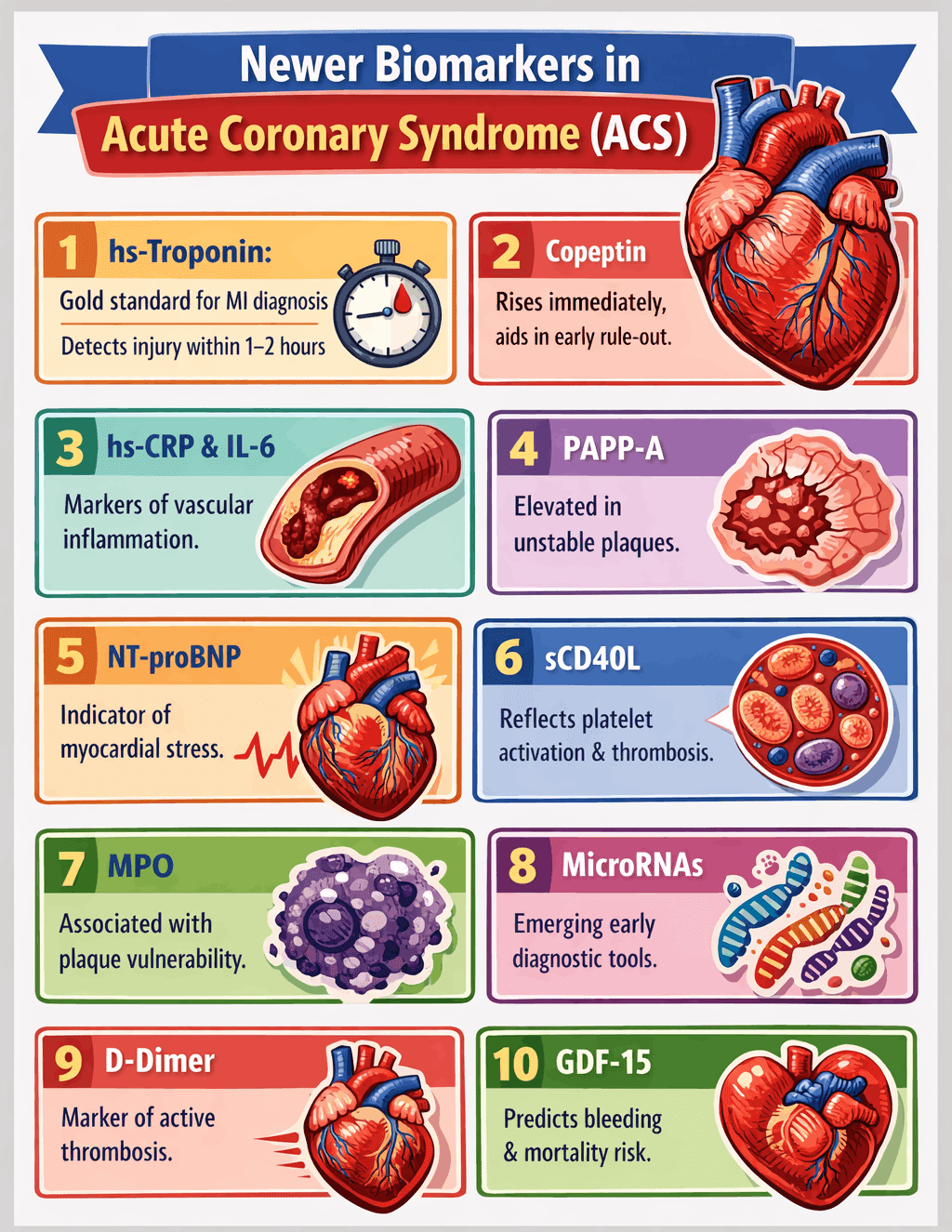
Newer biomarkers in acute coronarysyndrome
1. Novel Myocardial Injury / Necrosis Biomarkers
High-Sensitivity Cardiac Troponin (hs-cTnI / hs-cTnT)
Although now standard, they represent a newer generation.
- Detects injury within 1–2 hours
- Enables 0/1-hour and 0/2-hour rule-out algorithms
- Prognostic even at low-level elevations
- Limitation: non-ischemic elevations (CKD, sepsis, myocarditis)
Heart-Type Fatty Acid–Binding Protein (H-FABP)
- Cytosolic protein released earlier than troponin (1–3 hours)
- Useful in very early presenters
- Limited specificity
- Adjunctive, not standalone
2. Biomarkers of Myocardial Stress and Hemodynamic Load
Copeptin
(C-terminal portion of pro-vasopressin)
- Rises immediately after symptom onset
- Useful with negative initial troponin
- High negative predictive value for early rule-out
- Less useful once hs-troponins are available
BNP / NT-proBNP
- Reflects ventricular wall stress
- Strong prognostic marker in ACS
- Predicts:
- Heart failure
- Mortality
- Cardiogenic shock
- Not diagnostic of MI per se
3. Biomarkers of Inflammation and Plaque Instability
High-Sensitivity C-Reactive Protein (hs-CRP)
- Marker of vascular inflammation
- Predicts:
- Recurrent MI
- Mortality
- Independent of troponin
- Basis for anti-inflammatory strategies (e.g., COLCOT, CANTOS)
Interleukin-6 (IL-6)
- Central inflammatory cytokine
- Correlates with:
- Plaque instability
- Infarct size
- Prognostic rather than diagnostic
Myeloperoxidase (MPO)
- Released from activated neutrophils
- Reflects plaque vulnerability
- Elevated even before troponin rise
- Associated with recurrent ischemic events
4. Biomarkers of Plaque Rupture and Thrombosis
Pregnancy-Associated Plasma Protein-A (PAPP-A)
- Metalloproteinase involved in plaque rupture
- Elevated in unstable plaques
- Less reliable with statin or heparin therapy
Soluble CD40 Ligand (sCD40L)
- Marker of platelet activation
- Associated with thrombotic risk
- Limited clinical adoption
D-Dimer
- Reflects active thrombosis and fibrinolysis
- Prognostic in ACS
- High levels predict mortality and adverse outcomes
5. Biomarkers of Ischemia (Before Necrosis)
Ischemia-Modified Albumin (IMA)
- Altered albumin during ischemia
- Rises before necrosis
- Low specificity
- Rarely used now
6. Emerging and Experimental Biomarkers
MicroRNAs (miRNAs)
- Cardiac-specific (miR-1, miR-133, miR-208, miR-499)
- Rise early after myocardial injury
- Potential future role in:
- Early diagnosis
- Infarct phenotyping
- Currently research-level
Growth Differentiation Factor-15 (GDF-15)
- Stress-responsive cytokine
- Strong prognostic marker
- Incorporated into bleeding and mortality risk models
ST2 (Soluble Suppression of Tumorigenicity-2)
- Marker of myocardial fibrosis and stress
- Prognostic in ACS with heart failure
7. Practical Clinical Perspective (Exam + Real World)
| Purpose | Best Biomarkers |
|---|---|
| Early rule-out | hs-Troponin ± Copeptin |
| Risk stratification | hs-Troponin, NT-proBNP, GDF-15 |
| Inflammation | hs-CRP, IL-6 |
| Plaque instability | MPO, PAPP-A |
| Prognosis | NT-proBNP, hs-CRP, GDF-15 |
Key Take-Home Points
- hs-Troponin remains the cornerstone of ACS diagnosis
- Newer biomarkers are mainly adjunctive and prognostic
- Inflammation-related biomarkers are gaining importance due to therapeutic implications
- Most novel markers are not yet guideline-mandated for routine care
1. Which biomarker rises immediately after symptom onset and improves early ACS rule-out when combined with hs-troponin?
A. H-FABP
B. Copeptin
C. MPO
D. IMA
Copeptin reflects acute endogenous stress and rises before myocardial necrosis markers.
2. The major diagnostic limitation of high-sensitivity troponin assays is:
A. Poor sensitivity
B. Delayed elevation
C. Lack of ischemic specificity
D. Poor prognostic value
hs-Troponin detects myocardial injury, not ischemia alone.
3. Which biomarker best reflects plaque vulnerability rather than myocyte necrosis?
A. hs-cTnT
B. NT-proBNP
C. Myeloperoxidase
D. CK-MB
MPO is released from activated neutrophils and indicates unstable plaque biology.
4. Which ACS biomarker is significantly affected by heparin administration?
A. hs-CRP
B. PAPP-A
C. GDF-15
D. Copeptin
PAPP-A is heparin-sensitive, limiting its routine clinical use.
5. Which biomarker most strongly predicts short-term mortality in ACS independent of troponin?
A. IMA
B. NT-proBNP
C. H-FABP
D. CK-MB
NT-proBNP reflects ventricular wall stress and prognosis.
6. Biomarker that provided biological rationale for anti-inflammatory therapy in post-MI trials:
A. hs-CRP
B. D-dimer
C. Copeptin
D. ST2
hs-CRP underpinned CANTOS and COLCOT.
7. A biomarker elevated even before troponin rise and linked to recurrent ischemic events:
A. NT-proBNP
B. IL-6
C. MPO
D. ST2
MPO rises early and predicts future coronary events.
8. Marker reflecting platelet activation and thrombotic risk in ACS:
A. IL-6
B. sCD40L
C. hs-CRP
D. Copeptin
sCD40L reflects platelet-driven inflammation and thrombosis.
9. Which biomarker is mainly prognostic and incorporated into bleeding/mortality risk models?
A. IMA
B. MPO
C. GDF-15
D. H-FABP
GDF-15 is a stress cytokine strongly linked to adverse outcomes.
10. Biomarker that reflects ischemia before necrosis but has poor specificity:
A. Ischemia-modified albumin
B. hs-cTnI
C. NT-proBNP
D. CK-MB
IMA rises early but lacks specificity and is rarely used now.
11. A patient with NSTEMI has modest troponin rise but very high hs-CRP. This discordance best suggests:
A. Analytical troponin error
B. Reinfarction
C. High inflammatory plaque burden
D. Type 2 MI
hs-CRP reflects vascular inflammation and plaque activity, not infarct size.
NEET-SS trap: Prognosis may be poor despite small troponin rise.
12. Which biomarker improves early rule-out of MI specifically in very early presenters (<1 hour)?
A. GDF-15
B. Copeptin
C. NT-proBNP
D. IL-6
Copeptin rises immediately with endogenous stress.
Exam pearl: Value decreases once hs-troponin algorithms mature.
13. Which biomarker correlates best with recurrent ischemic events despite optimal DAPT?
A. hs-CRP
B. NT-proBNP
C. MPO
D. CK-MB
MPO reflects plaque vulnerability independent of thrombosis.
Trap: High MPO ≠ larger infarct.
14. Which biomarker is least useful once hs-troponin assays are universally available?
A. NT-proBNP
B. Copeptin
C. hs-CRP
D. GDF-15
hs-Troponin largely replaces copeptin for early diagnosis.
Still prognostic: Copeptin ≠ useless.
15. Which marker predicts heart failure and cardiogenic shock after ACS?
A. MPO
B. NT-proBNP
C. IMA
D. PAPP-A
NT-proBNP reflects LV wall stress and remodeling.
NEET-SS pearl: Stronger predictor than EF alone.
16. A biomarker integrated into bleeding-risk and mortality models in ACS:
A. hs-CRP
B. MPO
C. GDF-15
D. Copeptin
GDF-15 reflects cellular stress and frailty.
Exam trap: Not a diagnostic MI marker.
17. Which biomarker rises early but lacks specificity due to elevation in PE, sepsis, and stroke?
A. Ischemia-modified albumin
B. hs-Troponin
C. NT-proBNP
D. MPO
IMA detects ischemia, not coronary ischemia specifically.
Hence: Largely abandoned clinically.
18. Which biomarker reflects platelet-mediated inflammation and thrombosis?
A. IL-6
B. sCD40L
C. hs-CRP
D. NT-proBNP
sCD40L is released from activated platelets.
Exam link: Thrombo-inflammatory axis.
19. Which biomarker most closely correlates with infarct size on CMR?
A. hs-CRP
B. hs-Troponin
C. MPO
D. GDF-15
Troponin correlates with necrotic mass.
Trap: hs-CRP correlates with risk, not size.
20. Elevated D-dimer in ACS primarily indicates:
A. Larger infarct
B. Plaque rupture
C. Active thrombosis and fibrinolysis
D. LV remodeling
D-dimer is prognostic, not diagnostic.
Exam trap: High mortality predictor.
21. In a patient with CKD stage 4 and chest pain, which biomarker retains the highest prognostic value?
A. hs-Troponin
B. CK-MB
C. NT-proBNP
D. IMA
Troponin is often chronically elevated in CKD. NT-proBNP remains strongly prognostic.
NEET-SS trap: Diagnostic vs prognostic distinction.
22. Which biomarker best differentiates Type 1 MI from Type 2 MI?
A. hs-Troponin magnitude
B. MPO elevation
C. NT-proBNP
D. D-dimer
MPO reflects plaque rupture biology typical of Type-1 MI.
Trap: Troponin height alone cannot differentiate MI type.
23. A biomarker that predicts benefit from colchicine therapy post-ACS:
A. hs-CRP
B. NT-proBNP
C. GDF-15
D. MPO
Anti-inflammatory benefit is greatest when hs-CRP is elevated.
Exam link: COLCOT, CANTOS paradigm.
24. Which biomarker reflects myocardial fibrosis and adverse remodeling?
A. MPO
B. ST2
C. Copeptin
D. PAPP-A
ST2 signals myocardial stretch-fibrosis axis.
NEET-SS pearl: Complements NT-proBNP.
25. Which biomarker is most influenced by systemic inflammatory states like sepsis?
A. hs-CRP
B. MPO
C. hs-Troponin
D. NT-proBNP
hs-CRP is non-specific inflammation marker.
Trap: Does not localize pathology to coronaries.
26. Which biomarker shows promise for ultra-early diagnosis but remains research-level?
A. IMA
B. MPO
C. Cardiac microRNAs
D. sCD40L
miR-1, miR-133, miR-208 rise early but lack standardization.
27. Which biomarker elevation best predicts bleeding risk with aggressive antithrombotic therapy?
A. hs-CRP
B. NT-proBNP
C. GDF-15
D. MPO
GDF-15 integrates frailty, renal dysfunction, and bleeding risk.
28. A biomarker that may be elevated even before ECG changes:
A. CK-MB
B. Copeptin
C. NT-proBNP
D. hs-CRP
Stress hormone activation precedes electrical and necrotic changes.
29. Elevated hs-CRP with normal troponin most strongly predicts:
A. Large MI
B. False positive result
C. Future cardiovascular events
D. Heart failure
Inflammatory risk ≠ infarct size.
Exam trap: Long-term prognosis question.
30. Which biomarker is most useful for population-level risk stratification rather than bedside diagnosis?
A. hs-Troponin
B. hs-CRP
C. CK-MB
D. Copeptin
hs-CRP widely used in preventive cardiology.
31. Which biomarker is most affected by statin therapy?
A. hs-CRP
B. hs-Troponin
C. NT-proBNP
D. D-dimer
Statins reduce inflammation independent of LDL.
32. Which biomarker reflects both thrombotic burden and systemic hypercoagulability?
A. MPO
B. PAPP-A
C. D-dimer
D. hs-CRP
D-dimer integrates thrombosis + fibrinolysis.
33. Which biomarker is LEAST useful for diagnosing reinfarction?
A. CK-MB
B. Serial hs-Troponin delta
C. Clinical context
D. hs-CRP
Inflammation persists long after infarction.
34. Which biomarker best predicts sudden cardiac death post-MI?
A. hs-CRP
B. NT-proBNP
C. MPO
D. IMA
Reflects LV dysfunction and arrhythmic substrate.
35. A biomarker elevated in ACS but also predicts non-cardiovascular mortality:
A. hs-Troponin
B. MPO
C. GDF-15
D. CK-MB
Reflects global cellular stress and frailty.
36. Which biomarker best explains persistent risk despite optimal LDL lowering?
A. hs-Troponin
B. hs-CRP
C. NT-proBNP
D. CK-MB
Residual inflammatory risk persists despite lipid control.
Exam pearl: hs-CRP identifies candidates for anti-inflammatory therapy.
37. A biomarker elevated in ACS but unaffected by reperfusion success:
A. hs-Troponin
B. CK-MB
C. hs-CRP
D. Copeptin
Inflammation continues despite vessel patency.
Trap: Reperfusion lowers necrosis markers, not inflammatory ones.
38. Which biomarker combination best captures ischemia + necrosis + prognosis?
A. CK-MB + D-dimer
B. hs-Troponin + NT-proBNP
C. hs-CRP + MPO
D. Copeptin + IMA
Troponin = necrosis; NT-proBNP = hemodynamic stress.
NEET-SS insight: Dual-marker strategy improves risk stratification.
39. Which biomarker is most useful for identifying patients who benefit from early invasive strategy?
A. hs-Troponin
B. hs-CRP
C. D-dimer
D. IMA
Troponin-positive NSTE-ACS derives maximal benefit from invasive strategy.
40. A biomarker elevated in ACS, sepsis, malignancy, and aging — limiting specificity:
A. MPO
B. NT-proBNP
C. GDF-15
D. hs-Troponin
GDF-15 reflects generalized cellular stress.
Trap: Powerful prognostic but poor diagnostic marker.
41. Which biomarker best reflects the concept of “vulnerable patient” rather than “vulnerable plaque”?
A. MPO
B. PAPP-A
C. NT-proBNP
D. sCD40L
NT-proBNP integrates myocardial, renal, and systemic risk.
42. Which biomarker is most useful for identifying patients at risk of post-MI heart failure?
A. hs-CRP
B. NT-proBNP
C. MPO
D. IMA
NT-proBNP outperforms EF in early risk prediction.
43. Which biomarker is most influenced by circadian variation and stress response?
A. Copeptin
B. hs-Troponin
C. NT-proBNP
D. hs-CRP
Copeptin mirrors vasopressin stress-axis activation.
44. Which biomarker is LEAST affected by renal dysfunction?
A. NT-proBNP
B. hs-Troponin
C. GDF-15
D. hs-CRP
Inflammatory markers are least influenced by GFR.
45. Which biomarker most strongly correlates with long-term all-cause mortality?
A. hs-Troponin
B. MPO
C. GDF-15
D. CK-MB
GDF-15 integrates cardiovascular and non-cardiovascular risk.
46. Which biomarker is most useful for differentiating myocardial injury from myocardial infarction?
A. hs-Troponin absolute value
B. CK-MB
C. Clinical context + troponin delta
D. hs-CRP
Diagnosis of MI is biochemical + clinical, not biomarker alone.
47. Which biomarker is most useful in predicting arrhythmic risk post-MI?
A. hs-CRP
B. NT-proBNP
C. MPO
D. D-dimer
Reflects ventricular stretch and electrical instability substrate.
48. Which biomarker best reflects thrombo-inflammatory interaction?
A. hs-CRP
B. NT-proBNP
C. sCD40L
D. IMA
sCD40L bridges platelet activation and inflammation.
49. Which biomarker is most helpful in deciding intensity of secondary prevention?
A. CK-MB
B. hs-CRP
C. IMA
D. Copeptin
Persistent inflammation = need for aggressive risk modification.
50. The single most important limitation preventing routine use of most newer ACS biomarkers is:
A. Poor sensitivity
B. Poor reproducibility
C. Lack of guideline-mandated clinical impact
D. Cost alone
Most markers are prognostic without altering management decisions.
syndrome