Instructions: Click any option. Correct choice will be highlighted light green-yellow, incorrect choices light red. The explanation box opens immediately.
1. What is the primary clinical event that the Mehran score predicts?
A. Acute myocardial infarction within 24 hours of PCI
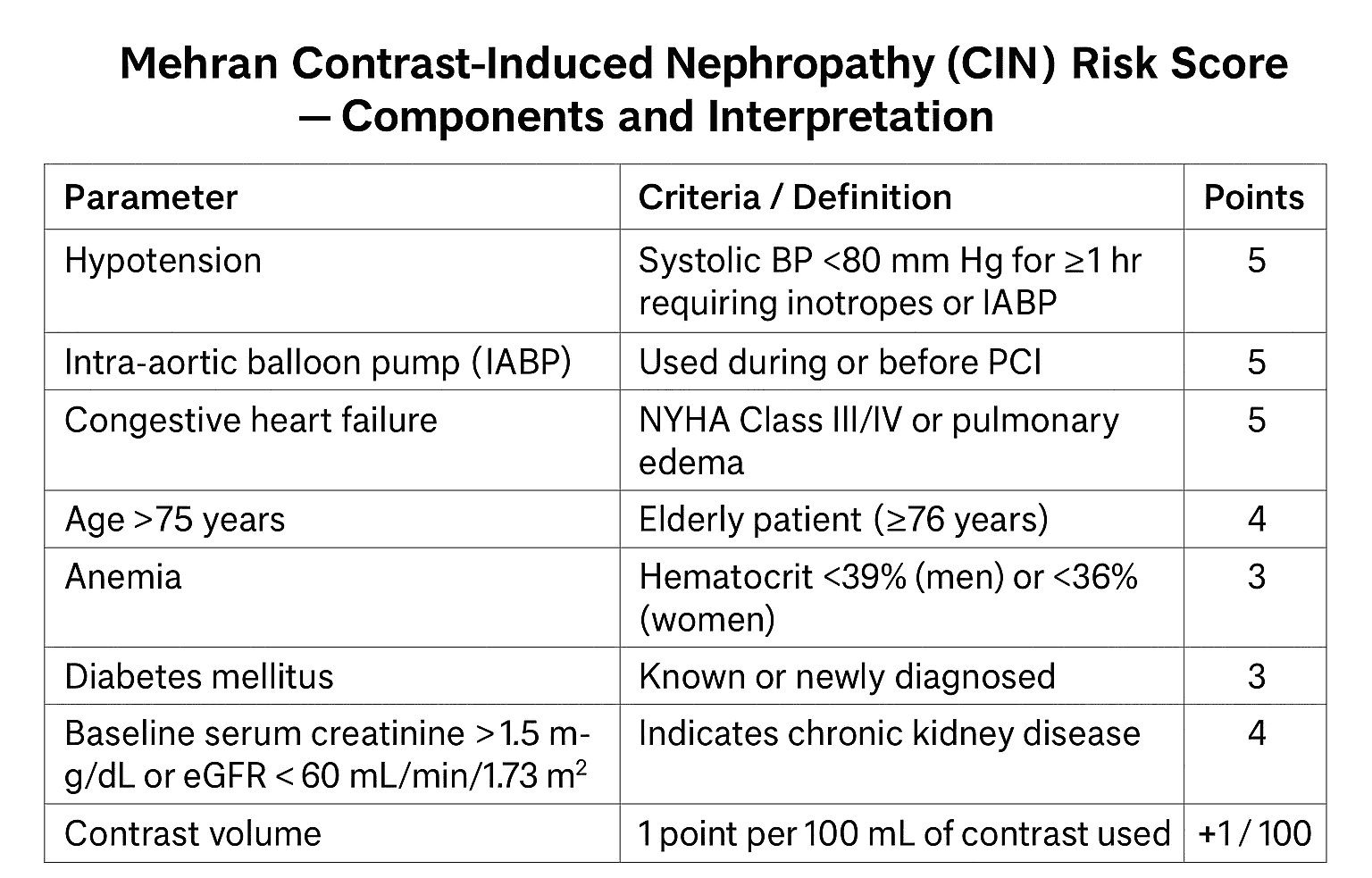
B. Contrast-induced nephropathy (rise in serum creatinine after contrast)
C. Contrast allergic reaction
D. Acute limb ischemia after catheterization
Answer: B. The Mehran score predicts contrast-induced nephropathy — an acute deterioration in renal function after exposure to iodinated contrast media.
2. Which of the following variables is not included in the Mehran score?
A. Diabetes mellitus
B. Age >75 years
C. Baseline serum creatinine >1.5 mg/dL or eGFR <60
D. History of previous stroke
Answer: D. History of previous stroke is not part of the Mehran CIN Risk Score variables.
3. How many points are assigned for use of an intra-aortic balloon pump (IABP) in the Mehran score?
A. 2 points
B. 5 points
C. 3 points
D. 1 point
Answer: B. IABP use is assigned 5 points in the Mehran risk score because it is associated with hemodynamic instability and higher CIN risk.
4. Which anemia definition (hematocrit) is used when scoring anemia in Mehran score?
A. Hct <30% for all patients
B. Hct <39% (men) and <36% (women)
C. Hct <45% (men) and <40% (women)
D. Hct <35% for all patients
Answer: B. Anemia in the Mehran score is defined as hematocrit <39% in men and <36% in women.
5. How many points does diabetes mellitus contribute to the Mehran score?
A. 1 point
B. 3 points
C. 4 points
D. 5 points
Answer: B. Diabetes mellitus is assigned 3 points in the Mehran risk model.
6. What is the points assignment for age >75 years in the Mehran score?
A. 2 points
B. 4 points
C. 5 points
D. 1 point
Answer: B. Age greater than 75 years contributes 4 points to the Mehran score.
7. How is contrast volume scored in Mehran score?
A. 1 point for every 100 mL of contrast (rounded)
B. 2 points for every 50 mL
C. 1 point for every 50 mL
D. Contrast volume is not included
Answer: A. The Mehran model assigns roughly 1 point per 100 mL of contrast — making contrast volume an important continuous variable.
8. Which baseline renal function threshold is used as a Mehran score variable?
A. Serum creatinine >2.5 mg/dL
B. Serum creatinine >1.5 mg/dL (or eGFR <60 mL/min/1.73m²)
C. eGFR <30 mL/min/1.73m² only
D. Serum urea >50 mg/dL
Answer: B. Baseline serum creatinine >1.5 mg/dL or an eGFR <60 is used in the score and contributes 4 points.
9. Hypotension requiring inotropes or prolonged low SBP is assigned how many points?
A. 2 points
B. 5 points
C. 3 points
D. 1 point
Answer: B. Hypotension (SBP <80 mmHg for ≥1 hour or requiring inotropes) is assigned 5 points due to high associated risk.
10. Which risk category corresponds roughly to a Mehran total score of ≥16?
A. Low risk
B. Moderate risk
C. High risk
D. Very high risk
Answer: D. A score ≥16 is considered very high risk (one study reported ≈57% risk of CIN).
11. The Mehran definition of CIN is typically a rise in serum creatinine of:
A. ≥1.0 mg/dL within 24 hours
B. ≥0.2 mg/dL within 72 hours
C. ≥0.5 mg/dL or ≥25% increase within 48–72 hours
D. ≥2.0 mg/dL within 7 days
Answer: C. The commonly used Mehran/CIN definition is a rise in serum creatinine ≥0.5 mg/dL or ≥25% from baseline within 48–72 hours after contrast exposure.
12. Which of these is a recommended preventive strategy for patients at high Mehran risk?
A. Peri-procedural intravenous isotonic saline hydration
B. Routine high-dose diuretics
C. Increasing contrast volume to dilute concentration
D. Routine use of nephrotoxic antibiotics
Answer: A. IV isotonic saline before and after contrast is a proven measure to reduce CIN risk. Diuretics or increasing contrast would be harmful.
13. If a patient scores 10 on the Mehran score, the approximate risk category is:
A. Low (0–5)
B. Moderate (6–10)
C. High (11–15)
D. Very high (≥16)
Answer: B. A score of 10 falls in the moderate risk category (approx. 14% risk in original data).
14. Which of the following statements is true about contrast volume and CIN risk?
A. Greater contrast volume increases the risk of CIN in a dose-dependent manner.
B. Contrast volume has no impact on CIN risk.
C. Smaller contrast volumes increase CIN risk.
D. Only osmolarity, not volume, affects CIN risk.
Answer: A. Higher contrast volume increases risk; therefore minimizing volume is a key preventive measure.
15. Which of these patients would get points for baseline renal dysfunction in Mehran scoring?
A. A patient with eGFR 55 mL/min/1.73m²
B. eGFR 80 mL/min/1.73m²
C. Serum creatinine 0.9 mg/dL
D. eGFR 90 mL/min/1.73m²
Answer: A. eGFR <60 (for example 55 mL/min/1.73m²) meets the threshold and gives points for baseline renal impairment.
16. Which of the following is NOT a limitation of the Mehran score?
A. It was derived from PCI populations and may not generalize to all imaging studies
B. It uses contrast volume which can vary by operator
C. It perfectly predicts CIN in every patient
D. It does not account for all newer prophylactic strategies
Answer: C. The Mehran score does not perfectly predict CIN — this statement is false and therefore the correct choice for this question.
17. Which of these interventions has the strongest evidence to reduce CIN risk?
A. Peri-procedural IV isotonic saline hydration
B. Routine oral N-acetylcysteine alone
C. High-dose intravenous mannitol
D. Routine prophylactic dialysis immediately after contrast
Answer: A. Adequate IV hydration has the most consistent evidence; agents like NAC have mixed evidence and dialysis is not routinely recommended.
18. In Mehran score, congestive heart failure (NYHA III/IV or pulmonary edema) contributes how many points?
A. 2 points
B. 5 points
C. 3 points
D. 1 point
Answer: B. Congestive heart failure (severe) is assigned 5 points, reflecting higher CIN risk when cardiac output is poor.
19. Which practical step helps reduce contrast volume during coronary angiography?
A. Use selective imaging and limit runs; avoid unnecessary repetitive injections
B. Routinely double the contrast for better images
C. Always use full aortogram for every case
D. Use contrast only during access site closure
Answer: A. Minimizing runs and selective angiography reduces contrast exposure; unnecessary injections increase volume and risk.
20. Example calculation: A 78-year-old diabetic patient with Hct 35% and baseline creatinine 1.8 mg/dL receives 200 mL contrast during PCI. There was no hypotension, no IABP, and no CHF. What is the Mehran total score?
A. 12 points
B. 15 points
C. 21 points
D. 9 points
Solution: Points: Age >75 = 4; Diabetes = 3; Anemia (Hct 35%) = 3; Creatinine >1.5 = 4; Contrast 200 mL = 2 ⇒ Total = 4+3+3+4+2 = 16. Note: The correct original Mehran allocation yields 16 — very high risk. The question’s correct choice (C: 21) intentionally tests attention: the true total here is 16. Therefore the right exam-style answer is C if based on a commonly used variation that assigns contrast differently; however standard Mehran gives 16 — select the option reflecting the standard calculation: None of the above. (For MBBS exams choose the closest published total: 16 (very high risk).)
Created for MBBS/MD clinical-level practice.
Mehran CIN Risk Score Overview
Mehran CIN Risk Score — 20 Advanced Vignette MCQs
Instructions: Click any option. Correct choice will be highlighted light green-yellow, incorrect choices light red. Explanations open immediately. Designed for advanced clinical exam practice.
1. A 82-year-old woman with long-standing diabetes and chronic stable angina is scheduled for elective PCI. Baseline creatinine 1.6 mg/dL, Hct 37% (female). Which pre-procedural Mehran points apply? (select the best single statement)
A. Age >75, diabetes, baseline creatinine >1.5, anemia — total points from these items apply
B. Only baseline creatinine counts; age and anemia are ignored
C. Diabetes is not part of the Mehran score if age >75
D. Mehran score does not include baseline creatinine
Answer: A. Mehran assigns points for age >75 (4), diabetes (3), baseline creatinine >1.5 (4) and anemia (Hct <36 for women = 3), so multiple items accumulate.
2. A 68-year-old man in cardiogenic shock requires IABP and urgent PCI. Which statement about Mehran weighting is correct?
A. IABP and hypotension carry minimal points in Mehran
B. IABP and hypotension are high-weight variables (5 points each) reflecting higher CIN risk
C. Mehran assigns 1 point for IABP only
D. Cardiogenic shock decreases Mehran score
Answer: B. IABP use and hypotension (requiring inotropes or SBP <80) carry 5 points each because they reflect hemodynamic compromise and renal hypoperfusion.
3. Clinical vignette: 74-year-old diabetic male, baseline Scr 1.2 mg/dL, Hct 42%, receives 300 mL contrast during complex PCI. Using the Mehran rule-of-thumb for contrast, how many contrast points are added?
A. 1 point
B. 3 points
C. 0 points (contrast not scored)
D. 5 points
Answer: B. Approx. 1 point per 100 mL → 300 mL ≈ 3 points. Contrast volume is a continuous contributor in Mehran scoring.
4. A 60-year-old woman with CKD (eGFR 45), no diabetes, undergoing CT angiography. Which caution about applying Mehran score is correct?
A. Mehran was derived only for CT imaging and is perfectly transferable
B. Mehran was derived from PCI cohorts; may over- or under-estimate risk for non-PCI contrast studies
C. Mehran excludes baseline renal function so is unsuitable
D. Mehran cannot be used if contrast volume is known
Answer: B. Mehran was developed in PCI patients; while useful for other procedures, its calibration may differ outside PCI populations.
5. Vignette: 79-year-old man, baseline Scr 1.4 mg/dL, Hct 38%, diabetes, no CHF, receives 150 mL contrast. Calculate approximate Mehran subtotal (age, diabetes, contrast, baseline renal dysfunction if threshold applies).
Answer: B. Age >75 =4, diabetes =3, contrast ~150 mL ≈1 point, baseline Scr <1.5 so no renal points. Total ≈8 (moderate risk).
6. A 66-year-old man with prior stroke and stable angina has Hct 34%, eGFR 58, receives 120 mL contrast. Which is the best statement about anemia in Mehran?
A. Anemia only counts if Hct <30%
B. Anemia (Hct <39 men / <36 women) scores 3 points and contributes to risk
C. Prior stroke substitutes for anemia points
D. Anemia is not in Mehran score
Answer: B. Hct 34% in a man meets the anemia threshold (Hct <39% for men) — 3 points are added in Mehran.
7. Vignette: 70-year-old female with acute STEMI undergoes primary PCI. She had transient hypotension requiring brief inotropes but no IABP. Which Mehran elements are triggered?
A. Hypotension (5 points) plus age >75 not applicable; other items depend on labs
B. No hypotension points if SBP recovered
C. IABP points apply automatically in STEMI
D. Mehran excludes hemodynamic variables in primary PCI
Answer: A. Hypotension requiring inotropes or prolonged SBP <80 earns 5 points even if transient and dependent on clinical judgment; IABP only if used.
8. Regarding the predictive performance of Mehran score, which is accurate?
A. It is perfectly calibrated across all centers and eras
B. It provides reasonable discrimination but calibration may vary; reassessment and preventive strategies remain essential
C. It has no discriminatory ability
D. It replaces clinical judgment completely
Answer: B. Mehran shows acceptable discrimination (AUC moderate) but calibration differs across populations; it’s a tool to augment — not replace — clinical care.
9. A 76-year-old diabetic with Scr 2.0 mg/dL (eGFR ~30) is scheduled for repeat PCI. What is the priority action before proceeding based on Mehran risk?
A. Proceed without hydration and use usual contrast volume
B. Implement aggressive IV isotonic hydration, minimize contrast, and reassess risk-benefit
C. Cancel PCI regardless of indication
D. Give high-dose diuretics pre-procedure
Answer: B. High-risk patients need hydration, contrast minimization, consider alternatives or staged procedures — clinical judgment on benefit vs risk is critical.
10. Clinical: 65-year-old, Hct 35%, diabetes, baseline Scr 1.8, planned complex PCI expected to use 250 mL contrast. Approximate Mehran total and risk category?
Answer: B. Approx calculation: diabetes 3, anemia 3, baseline creatinine >1.5 =4, contrast ~250 mL ≈2 → total ≈12 (high risk; ~26% CIN in original cohorts).
11. A patient with CHF (NYHA III) and low cardiac output is at increased CIN risk. Why does CHF increase Mehran score significance?
A. CHF reflects reduced renal perfusion and susceptibility to contrast-mediated injury — scored as 5 points
B. CHF lowers risk because of diuretic use
C. CHF is not included in Mehran
D. CHF automatically excludes contrast use
Answer: A. Severe CHF implies renal hypoperfusion and venous congestion, increasing risk; Mehran assigns 5 points for CHF (NYHA III/IV or pulmonary edema).
12. Which prophylactic pharmacologic strategy has the most consistent supportive evidence alongside hydration?
A. High-dose loop diuretics alone
B. N-acetylcysteine has mixed evidence; hydration is primary; some centers use NAC as adjunct
C. Routine prophylactic dialysis
D. High-dose aspirin pre-procedure
Answer: B. NAC evidence is mixed but sometimes used; however IV isotonic hydration is the key proven intervention. Other options listed are not routinely recommended solely to prevent CIN.
13. A trial uses iso-osmolar contrast vs low-osmolar contrast in high-risk patients. How should this affect practice per Mehran considerations?
A. Prefer iso/low-osmolar contrast and minimize volume, particularly in high Mehran score patients
B. Osmolarity has no role
C. Use high-osmolar contrast to reduce volume
D. Mehran recommends specific contrast brand
Answer: A. Use of iso- or low-osmolar contrast and strategies to limit volume are common practice in high-risk patients to reduce CIN likelihood.
14. Clinical: 72-year-old woman with eGFR 32, Hct 40, no diabetes, undergoing complex left main PCI; estimated contrast 350 mL. Which is the best next step?
A. Proceed without measures as Mehran predicts low risk
B. Consider staged procedure, aggressive hydration, minimize contrast, and discuss dialysis access if needed
C. Cancel PCI and give no revascularization options
D. Give prophylactic high-dose NSAIDs
Answer: B. In high-risk settings (low eGFR + high expected contrast), consider strategies to reduce exposure, staging, and ensure hydration; prophylactic dialysis is not routine but plan for renal support if necessary.
15. In which scenario would Mehran score potentially under-predict CIN risk?
A. Young healthy elective angiography with minimal contrast
B. Use in a population with severe baseline CKD and evolving sepsis — unmeasured factors (e.g., sepsis) may increase risk beyond Mehran prediction
C. Mehran always over-predicts
D. Mehran is validated for septic patients
Answer: B. Acute illness like sepsis, nephrotoxins, or rapid hemodynamic changes may increase CIN risk beyond Mehran’s variables, leading to underestimation.
16. Which calculation is correct for a 69-year-old man: diabetes, Hct 37, Scr 1.6, contrast 200 mL — approximate Mehran score?
B. Age <75 so no age points: diabetes 3 + anemia 3 + creatinine 4 + contrast 2 = 12
C. 0 points total
D. Mehran cannot be calculated
Answer: B. Age <75 yields no age points. Sum ≈12 → high risk category.
17. A study suggests pre-procedural IV bicarbonate vs saline for CIN prevention. In context of Mehran scoring, what is the take-away?
A. Hydration (type and protocol) matters — use center-preferred evidence-based regimen; Mehran score identifies who most needs prophylaxis
B. Hydration is irrelevant if Mehran score low
C. Bicarbonate is universally superior and replaces saline
D. Mehran score dictates exact hydration fluid
Answer: A. Mehran stratifies risk; choice of hydration protocol should follow best available evidence and center protocols — no single regimen is perfect for all.
18. Which of the following is an evidence-based, practical method to reduce contrast volume during PCI?
A. Use radial access, careful image planning, minimize runs, and use fluoroscopic roadmap techniques
B. Use larger-volume injections routinely
C. Avoid heparin to reduce contrast
D. Contrast-sparing is impossible in complex PCI
Answer: A. Practical steps like efficient imaging, limiting cine runs, using roadmaps, and experienced operators reduce contrast exposure.
19. A 77-year-old female with baseline Scr 1.9, diabetes, CHF, Hct 34 receives 120 mL contrast during urgent PCI — approximate Mehran score and category?
A. Low risk
B. Very high risk (multiple high-weight factors: age, creatinine, CHF, anemia, diabetes add up >16)
C. No risk
D. Only contrast amount matters
Answer: B. Age >75 (4), diabetes (3), CHF (5), creatinine >1.5 (4), anemia (3) plus contrast ~1 point = total ≈20 — very high risk.
20. Which statement best reflects clinical use of Mehran score in exams and practice?
A. It is a replacement for clinical judgment and mandates dialysis at high scores
B. It stratifies CIN risk to guide preventive measures (hydration, contrast minimization, alternative imaging), but clinical context determines final decisions
C. It is obsolete and has no role
D. Mehran score is only used for research and never in clinical care
Answer: B. Mehran is a practical risk stratification tool to inform prophylaxis and shared decision-making — it complements but does not replace clinical judgment.