Lhermitte’s Sign
Lhermitte’s Sign
Definition
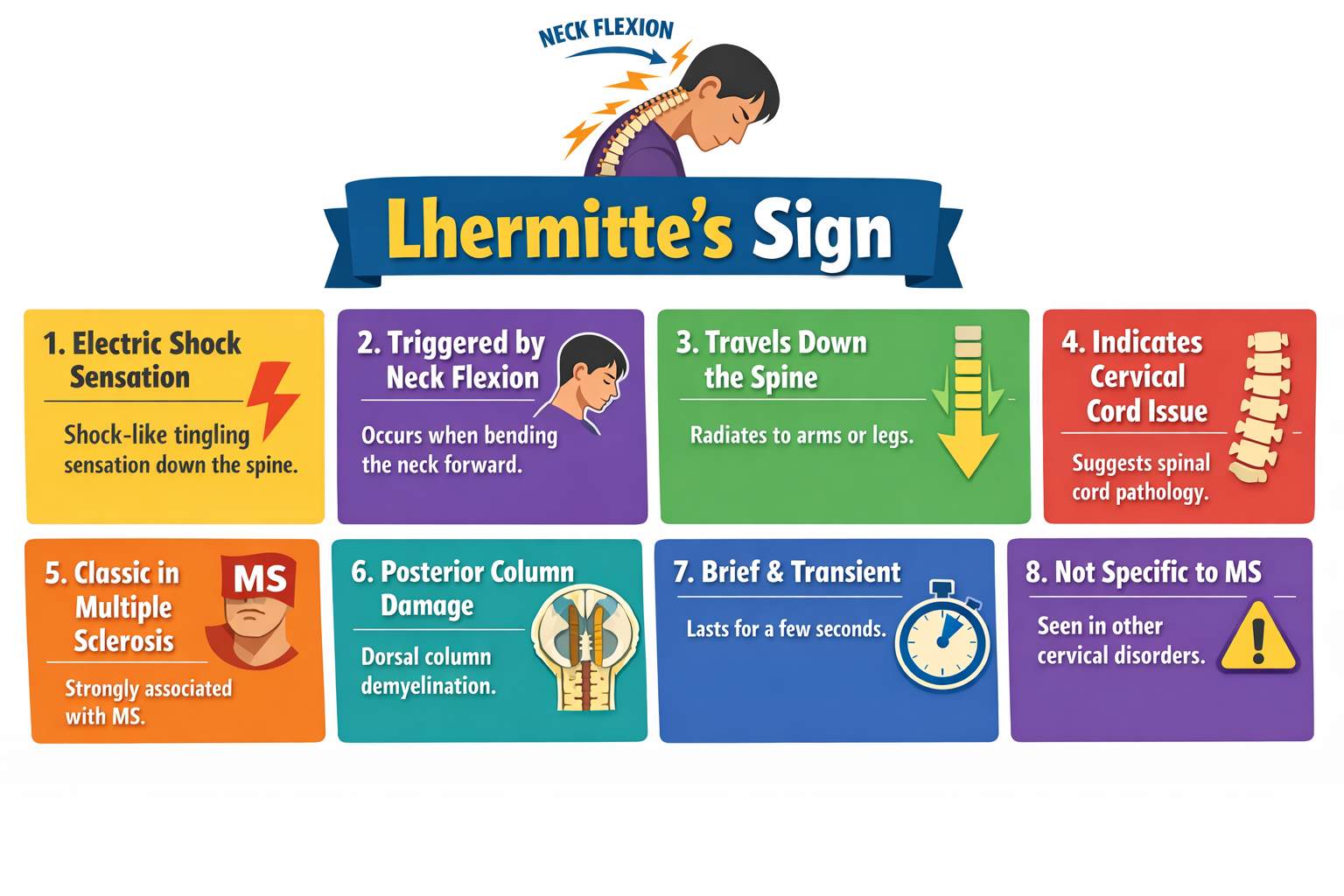
Lhermitte’s sign is a transient electric-shock–like sensation that travels down the spine and often into the limbs when the neck is flexed.
It reflects dorsal column (posterior column) irritation or demyelination in the cervical spinal cord.
🧠 Mechanism
Neck flexion stretches demyelinated posterior column fibers, producing ectopic nerve impulses, perceived as an electric shock sensation.
📍 Classic Clinical Associations
| Condition | Explanation |
|---|---|
| Multiple Sclerosis | Most classic association due to cervical cord demyelination |
| Cervical Spondylotic Myelopathy | Compression of dorsal columns |
| Vitamin B12 Deficiency | Posterior column degeneration |
| Radiation Myelopathy | Delayed demyelination after radiation therapy |
| Cervical Disc Herniation | Mechanical irritation of spinal cord |
| Behçet Disease | Rare neuro-Behçet involvement |
🔎 Key Clinical Features
- Trigger: Neck flexion
- Sensation: Electric shock / tingling
- Direction: Down the spine → arms or legs
- Duration: Seconds
🧪 Examination Maneuver
- Ask patient to flex the neck forward.
- Positive test: sudden electric shock sensation along the spine.
⚠️ Important Exam Pearls
- Suggests cervical cord pathology.
- Highly suggestive but not specific for Multiple Sclerosis.
- Often indicates posterior column demyelination.
🧾 Differential Signs
| Sign | Feature |
|---|---|
| Spurling Sign | Cervical radiculopathy |
| Romberg Sign | Posterior column sensory ataxia |
| Babinski Sign | Upper motor neuron lesion |
🧠 NEET-SS / Neurology Exam One-liner
“Electric shock down spine on neck flexion = think cervical dorsal column demyelination (classically Multiple Sclerosis).”
1. Lhermitte’s sign is best described as:
A. Burning neck pain on extension
B. Electric shock sensation down spine on neck flexion
C. Facial numbness during chewing
D. Sudden limb weakness with coughing
Electric shock sensation radiating down the spine when the neck flexes defines :contentReference[oaicite:1]{index=1}>.
2. Lhermitte’s sign most commonly indicates pathology in the:
A. Lumbar spinal cord
B. Thoracic spinal cord
C. Cervical spinal cord
D. Sacral nerve roots
Lhermitte’s sign reflects irritation or demyelination of cervical dorsal columns.
3. The tract primarily responsible for Lhermitte’s sign is:
A. Corticospinal tract
B. Spinothalamic tract
C. Posterior (dorsal) columns
D. Rubrospinal tract
Posterior column demyelination produces ectopic impulses when stretched during neck flexion.
4. The most classical disease associated with Lhermitte’s sign is:
A. Myasthenia gravis
B. Multiple sclerosis
C. Parkinson disease
D. Huntington disease
Cervical spinal cord demyelination in multiple sclerosis commonly produces Lhermitte’s sign.
5. Lhermitte’s sign is typically triggered by:
A. Neck extension
B. Neck flexion
C. Shoulder abduction
D. Lumbar flexion
Forward neck flexion stretches the cervical cord and triggers the electric shock sensation.
6. Which deficiency may cause Lhermitte’s sign due to posterior column degeneration?
A. Vitamin A deficiency
B. Vitamin C deficiency
C. Vitamin B12 deficiency
D. Vitamin K deficiency
Vitamin B12 deficiency causes subacute combined degeneration affecting posterior columns.
7. The electric sensation of Lhermitte’s sign usually radiates:
A. From abdomen upward
B. Only around the neck
C. Down the spine into limbs
D. From legs upward
Patients typically feel a shock-like sensation descending along the spine and sometimes into arms or legs.
8. The duration of Lhermitte’s sign sensation is usually:
A. Several hours
B. 30 minutes
C. A few seconds
D. Several days
The shock sensation is brief and transient.
9. Which degenerative spinal disorder may cause Lhermitte’s sign?
A. Lumbar disc prolapse
B. Cervical spondylotic myelopathy
C. Spina bifida
D. Ankylosing spondylitis
Compression of the cervical spinal cord can irritate dorsal columns and produce the sign.
10. Lhermitte’s sign is best classified as a:
A. Motor reflex
B. Sensory phenomenon
C. Autonomic reflex
D. Cranial nerve reflex
It is a sensory phenomenon caused by irritation of posterior column fibers in the cervical spinal cord.
A. Corticospinal fibers
B. Spinothalamic tract
C. Demyelinated posterior column fibers
D. Anterior horn cells
Neck flexion stretches demyelinated posterior column fibers producing an electric shock sensation.
12. Lhermitte’s sign may be seen following radiation therapy to the:
A. Pelvis
B. Abdomen
C. Cervical region
D. Lower limbs
Radiation-induced cervical myelopathy can produce transient Lhermitte’s phenomenon.
13. Which inflammatory disorder may rarely produce Lhermitte’s sign?
A. Rheumatic fever
B. Kawasaki disease
C. Behçet disease
D. Takayasu arteritis
Neuro-Behçet disease affecting the cervical spinal cord can cause Lhermitte’s sign.
14. Which symptom description best matches Lhermitte’s sign?
A. Sudden shooting pain from hip to leg
B. Electric shock sensation radiating down the spine on neck flexion
C. Burning pain over scalp
D. Tingling limited to fingertips
Patients describe a transient electric shock-like sensation traveling down the spine.
15. The underlying mechanism of Lhermitte’s sign involves:
A. Compression of peripheral nerves
B. Muscle fiber hyperexcitability
C. Ectopic impulse generation in demyelinated fibers
D. Synaptic failure in spinal cord
Demyelinated posterior column fibers become electrically unstable when stretched.
16. Lhermitte’s sign is considered:
A. Pathognomonic for multiple sclerosis
B. Suggestive but not specific for cervical cord pathology
C. A peripheral neuropathy sign
D. A cerebellar sign
Although classically associated with multiple sclerosis, the sign can occur in several cervical spinal cord disorders.
17. Lhermitte’s sign indicates irritation of which anatomical structure?
A. Anterior horn cells
B. Lateral corticospinal tract
C. Posterior columns of spinal cord
D. Cauda equina
The sign occurs due to stretching of demyelinated posterior column fibers in the cervical spinal cord.
18. Which spinal level is most commonly involved in Lhermitte’s sign?
A. Lumbar
B. Thoracic
C. Cervical
D. Sacral
The phenomenon is produced when the cervical spinal cord is stretched during neck flexion.
19. Which malignancy treatment can precipitate Lhermitte’s sign months after therapy?
A. Chemotherapy for leukemia
B. Radiotherapy to lumbar spine
C. Cervical spinal cord radiation
D. Thyroid radioiodine therapy
Radiation-induced cervical myelopathy may transiently produce Lhermitte’s phenomenon.
20. Which infection has been reported to cause Lhermitte’s sign due to cervical myelitis?
A. Rabies
B. Herpes zoster
C. Dengue
D. Hepatitis B
Viral myelitis involving dorsal columns can produce Lhermitte’s phenomenon.
21. Which metabolic disorder may produce Lhermitte’s sign due to demyelination?
A. Hypocalcemia
B. Hyponatremia
C. Vitamin B12 deficiency
D. Iron deficiency
Subacute combined degeneration affects posterior columns and may cause the sign.
22. The pathophysiological mechanism of Lhermitte’s sign involves:
A. Synaptic inhibition
B. Motor neuron hyperexcitability
C. Stretch-induced ectopic impulses in demyelinated fibers
D. Peripheral nerve compression
Neck flexion stretches demyelinated dorsal column fibers causing abnormal electrical discharges.
23. Which cervical spinal pathology can mimic Lhermitte’s sign?
A. Cervical radiculopathy
B. Cervical spondylotic myelopathy
C. Brachial plexus injury
D. Thoracic outlet syndrome
Cervical spinal cord compression can irritate posterior columns producing the shock sensation.
24. Lhermitte’s sign is most closely associated with dysfunction of which sensory modality?
A. Pain
B. Temperature
C. Proprioception
D. Olfaction
Posterior columns transmit vibration and proprioception, explaining the involvement.
25. Which maneuver best demonstrates Lhermitte’s sign clinically?
A. Shoulder abduction
B. Lumbar extension
C. Passive neck flexion
D. Straight leg raise
Neck flexion stretches the cervical cord and provokes the characteristic electric shock sensation.