Faget sign – Relative bradycardia
Faget sign is often seen in:
- Yellow fever
- Typhoid fever
- Brain abscess
- Tularaemia
- Brucellosis
- Colorado tick fever
- Some pneumonias – Legionella pneumonia and Mycoplasma pneumonia
- Drug fever (e.g. beta-blockers, known as the Beta-Faget sign)
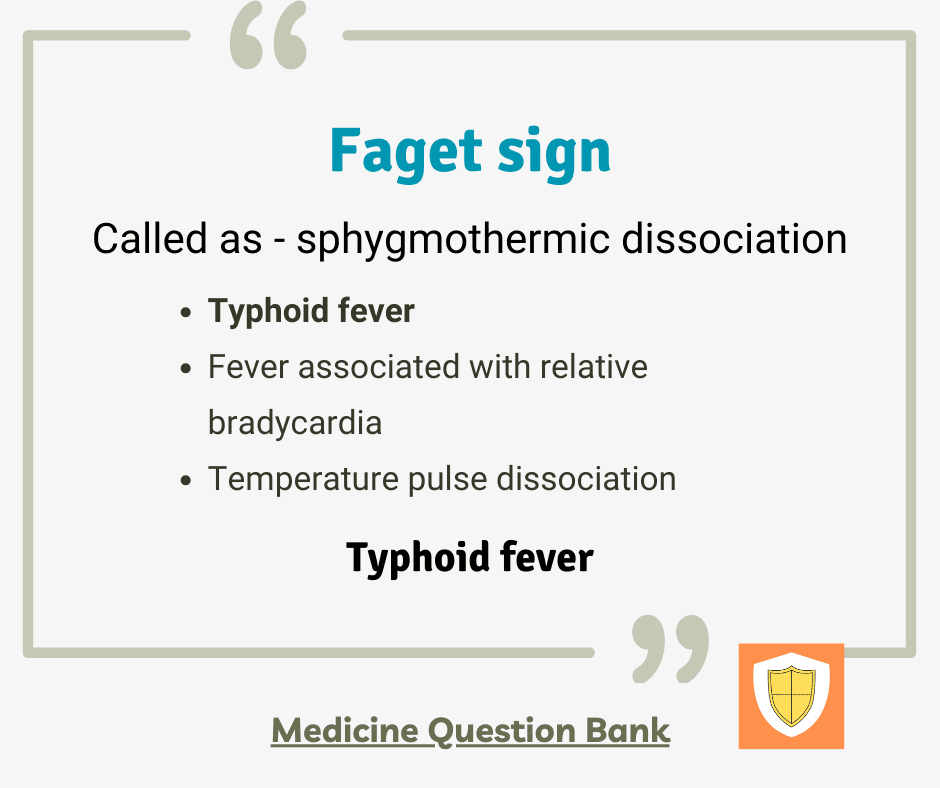
Faget sign – Relative bradycardia
- Fever is usually accompanied by tachycardia – called “Liebermeister’s rule“
- Faget sign is named after Louisiana physician Jean Charles Faget
- Fever associated with relative bradycardia – temperature pulse dissociation – Relatively pulse do not increase [ Relative bradycardia] with rise in high temperature
aget Sign – Relative Bradycardia
🔹 Definition:
The Faget sign refers to the paradoxical occurrence of relative bradycardia in the presence of fever. Normally, fever is associated with a proportional rise in heart rate (about 10 bpm per °C rise). In Faget sign, this expected tachycardia is absent or blunted.
🔹 Mechanism:
- Thought to result from direct pathogen or toxin effects on the cardiac conduction system,
- Or due to cytokine-mediated alteration of autonomic regulation.
🔹 Clinical Associations (Classically seen in):
- Typhoid fever (enteric fever)
- Yellow fever
- Brucellosis
- Tularemia
- Legionnaires’ disease
- Drug fever
- Some cases of malaria
🔹 Clinical relevance:
- Helps in differentiating specific infections from other causes of fever with proportional tachycardia.
- Not 100% specific, but when present, it can point toward particular infectious etiologies.
✅ Summary:
Faget sign = Fever + Relative bradycardia (pulse-temperature dissociation).
Classically described in typhoid and yellow fever, but also seen in other infections like brucellosis, tularemia, and Legionella pneumonia.
Q1. Faget sign is best described as:
Faget sign = paradoxical occurrence of fever with relative bradycardia.
Q2. Normally, for each rise of 1°C in body temperature, heart rate increases by approximately:
Normally, HR rises about 8–10 bpm per °C rise in temperature.
Q3. Faget sign is classically described in which disease?
Typhoid fever is the classical disease where Faget sign is observed.
Q4. Which of the following is NOT commonly associated with Faget sign?
Faget sign is seen in typhoid, yellow fever, brucellosis, tularemia, but not typically in influenza.
Q5. In Faget sign, the heart rate response to fever is:
In Faget sign, the tachycardia expected with fever is blunted or suppressed.
Q6. Relative bradycardia with fever is also termed as:
Relative bradycardia with fever is known as Faget sign.
Q7. A patient has fever of 39°C and a pulse of 84/min. This suggests:
A fever of 39°C should have HR > 110/min. A pulse of 84/min indicates Faget sign.
Q8. Which bacterial infection is a classic cause of Faget sign?
Salmonella Typhi (typhoid fever) is a classic cause of Faget sign.
Q9. Which zoonotic infection is linked with relative bradycardia?
Brucellosis is a zoonotic infection where Faget sign may be seen.
Q10. The underlying mechanism of Faget sign is thought to involve:
Faget sign is thought to result from vagal stimulation or toxin-mediated conduction effects.
Q11. Which of the following viral infections is classically linked to Faget sign?
Yellow fever is a classical viral cause of Faget sign.
Q12. Which atypical pneumonia is known to present with relative bradycardia?
Legionnaires’ disease (Legionella pneumonia) is associated with relative bradycardia.
Q13. Which feature helps differentiate Faget sign from typical febrile tachycardia?
Faget sign shows pulse-temperature dissociation: fever without proportional tachycardia.
Q14. Which historical physician is credited with describing the Faget sign?
The sign was described by Jean Charles Faget in yellow fever.
Q15. In typhoid fever, relative bradycardia occurs most prominently during:
Relative bradycardia in typhoid fever is usually observed in the first week.
Q16. A patient with fever of 40°C is expected to have a heart rate of ~120 bpm. Instead, HR is 88 bpm. This finding indicates:
Blunted HR rise despite high fever is diagnostic of Faget sign.
Q17. Which of the following diseases shows fever with relative bradycardia as an important diagnostic clue?
Tularemia is one of the classical bacterial diseases associated with relative bradycardia.
Q18. Which mechanism is most likely involved in Faget sign?
Pathogens/toxins and cytokines alter autonomic regulation and conduction, leading to bradycardia.
Q19. Which of the following statements about Faget sign is FALSE?
Faget sign is not exclusive to typhoid; it occurs in several infections.
Q20. The practical importance of recognizing Faget sign is:
Recognizing Faget sign helps clinicians suspect certain infections (typhoid, yellow fever, brucellosis, etc.) when evaluating fever.
| Feature | Normal Fever Response | Faget Sign (Relative Bradycardia) |
|---|---|---|
| Pulse–Temperature Relationship | HR rises ~8–10 bpm per 1°C rise in temperature | HR does not rise as expected (bradycardia relative to fever) |
| Heart Rate in 39°C fever | ~110 bpm | ~80–90 bpm |
| Mechanism | Sympathetic activation with fever | Vagal stimulation or toxin/cytokine effect on conduction system |
| Classical Bacterial Causes | – | Typhoid fever (Salmonella Typhi), Brucellosis, Tularemia |
| Classical Viral Causes | – | Yellow fever |
| Other Causes | – | Legionella pneumonia, Drug fever, Some cases of malaria |
| Clinical Use | Predictable tachycardia with fever | Clue to specific infections (pulse–temperature dissociation) |