Aortic Stenosis Risk Score
Aortic Stenosis Risk Score
Main Risk Scores / Models Used in Aortic Stenosis
1. Surgical Risk Scores (used for TAVR/SAVR decision-making)
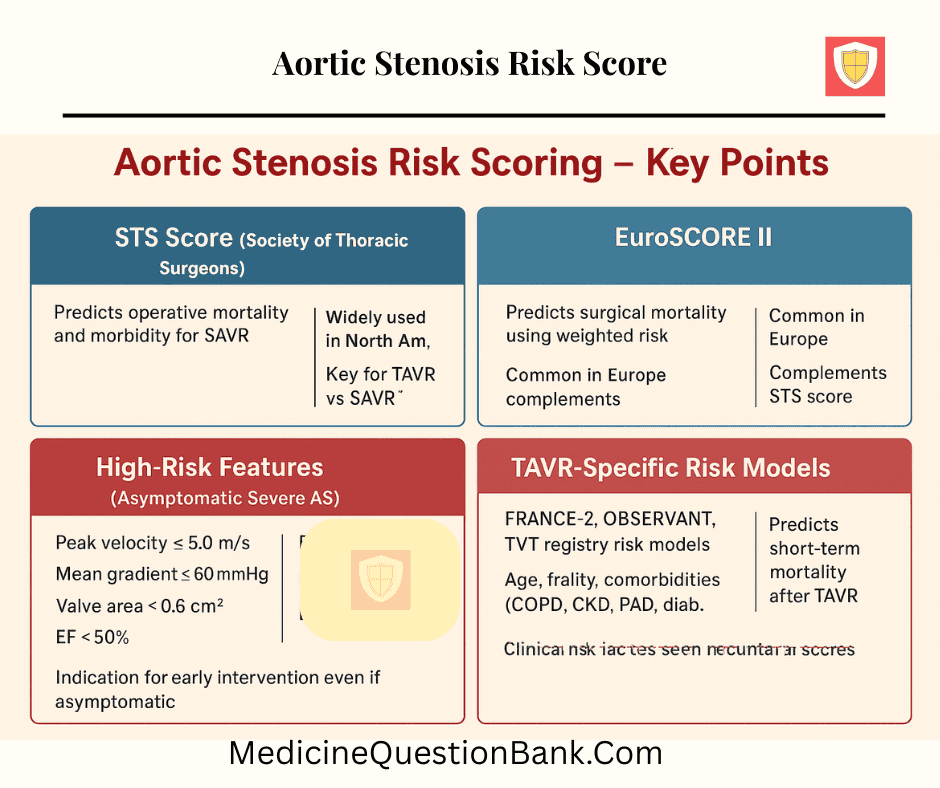
- STS (Society of Thoracic Surgeons) Predicted Risk of Mortality (PROM) score
- Estimates operative mortality and morbidity for surgical aortic valve replacement (SAVR).
- Widely used in North America.
- EuroSCORE II (European System for Cardiac Operative Risk Evaluation)
- Estimates mortality risk after cardiac surgery (including SAVR).
- Used more in Europe.
👉 These two are standard when evaluating if a patient is low-, intermediate-, or high-risk for surgery.
2. Risk Stratification in Asymptomatic Severe AS
For patients with severe AS but no symptoms, guidelines consider:
- Clinical factors:
- Age, frailty, comorbidities
- Rapid symptom onset
- Echocardiographic factors:
- Peak aortic jet velocity (>5.0 m/s)
- Mean gradient (>60 mmHg)
- Valve area (<0.6 cm²)
- Severe LV hypertrophy, reduced LVEF (<50%)
- Exercise testing:
- Abnormal blood pressure response
- Symptom provocation
- Biomarkers:
- Elevated BNP
- Rapid rise in serial measurements
These aren’t combined into a single numerical score, but guidelines (ACC/AHA, ESC) integrate them for decision-making.
3. TAVR-specific Risk Tools
- FRANCE-2 risk model (mortality predictors after TAVR)
- OBSERVANT risk score (Italy, TAVR outcomes)
- TVT Registry models (US, predicts in-hospital/30-day mortality)
✅ Summary for you:
- There is no “Aortic Stenosis Risk Score” like ADD-RS.
- In practice, we use STS PROM or EuroSCORE II for surgical/TAVR decisions, plus clinical/echo criteria for asymptomatic severe AS.
- Research models exist for TAVR risk, but not universally adopted.
Aortic Stenosis — Risk Scoring & Decision MCQs (20)
Select the best answer. Correct option will be highlighted; explanation will display immediately.
1. The STS Predicted Risk of Mortality (PROM) is primarily used to:
Answer: A. STS PROM estimates perioperative (30‑day) risk of mortality/morbidity and is used in surgical risk assessment (SAVR vs TAVR decisions).
2. EuroSCORE II is best described as:
Answer: B. EuroSCORE II predicts operative mortality for cardiac surgery using demographic and clinical variables.
3. Which echocardiographic parameter alone defines severe aortic stenosis according to most guidelines?
Answer: C. Peak aortic jet velocity >4.0 m/s is one of the primary criteria for severe AS (also mean gradient >40 mmHg or aortic valve area <1.0 cm²).
4. In an asymptomatic patient with severe AS, which finding would most strongly favor early intervention?
Answer: C. Rapid haemodynamic progression (e.g., >0.3 m/s per year) or very high peak velocity, reduced EF, or very severe valve area may prompt earlier intervention even if asymptomatic.
5. Which of the following increases the STS Predicted Risk of Mortality most significantly?
Answer: B. Urgent/emergency or salvage operations and critical pre‑operative states are major drivers of increased surgical mortality risk.
6. A low transvalvular gradient with low flow but small valve area describes:
Answer: B. Paradoxical low‑flow, low‑gradient severe AS occurs with small valve area but low gradients due to low stroke volume despite preserved EF in some patients.
7. Which biomarker is commonly used to help risk‑stratify patients with AS?
Answer: B. BNP (or NT‑proBNP) rises with increased LV wall stress and correlates with symptom development and prognosis in AS.
8. Which patient characteristic would most increase EuroSCORE II predicted mortality?
Answer: C. Active endocarditis, critical state, and other urgent/emergent features increase operative risk substantially in EuroSCORE II.
9. For TAVR candidate selection, which is NOT typically considered?
Answer: C. While durability matters, predicting prosthesis durability beyond decades is uncertain and less central than access, anatomy, frailty, and comorbidities when selecting TAVR.
10. A patient with severe AS and left ventricular ejection fraction 40% should:
Answer: B. Reduced LVEF (<50%) in severe AS is a guideline indication for aortic valve replacement even if symptoms are absent, because LV dysfunction may be due to afterload mismatch from AS.
11. The common threshold for high surgical risk in STS PROM is approximately:
Answer: D. Historically, >8% STS PROM has been used to define high surgical risk, though decision-making is individualized and thresholds have evolved with TAVR data.
12. In low‑flow, low‑gradient AS with reduced EF, which test helps distinguish true severe AS from pseudo‑severe AS?
Answer: A. Low‑dose dobutamine echo assesses contractile reserve and changes in valve area/gradient to differentiate true severe from pseudo‑severe AS.
13. Which comorbidity commonly increases both perioperative mortality and the likelihood of choosing TAVR over SAVR?
Answer: B. Frailty and limited life expectancy increase operative risk and often influence a decision toward less invasive TAVR when appropriate.
14. Which imaging modality is essential for procedural planning before TAVR?
Answer: A. CT angiography evaluates annulus size, root anatomy, coronary heights, and peripheral access — critical for TAVR planning.
15. Which of the following is TRUE regarding bioprosthetic valve thrombosis risk after TAVR?
Answer: B. Subclinical leaflet thrombosis (reduced leaflet motion) can be seen after TAVR and may increase gradients; anticoagulation decisions should be individualized.
16. A high STS score automatically means a patient should undergo TAVR rather than SAVR:
Answer: B. STS is important, but the heart team considers anatomy, frailty, life expectancy, and patient preference — not STS alone.
17. Which statement about surgical risk calculators is correct?
Answer: B. Risk models vary in variables and weighting; they inform but don’t replace individualized clinical decisions.
18. The presence of severe pulmonary hypertension in a patient with severe AS generally:
Answer: B. Severe pulmonary hypertension increases complexity and risk and is considered in heart team discussions for AVR strategy.
19. After calculating a high predicted surgical mortality, the appropriate next step is:
Answer: B. High risk prompts detailed heart‑team discussion, shared decision‑making, and consideration of TAVR vs SAVR vs conservative management based on goals of care.
20. Which factor is LEAST likely to directly impact the numerical score in STS/EUROSCORE calculators?
Answer: C. Socioeconomic status is not typically a variable in these surgical risk models, though it can affect access and outcomes; models focus on clinical and procedural factors.
Educational MCQs — not for assessment.
Aortic Stenosis Risk Scoring – Key Points
| Category | Key Features | Clinical Relevance |
|---|---|---|
| STS Score (Society of Thoracic Surgeons) | Predicts operative mortality & morbidity for SAVR | Widely used in North America; key for TAVR vs SAVR decision |
| EuroSCORE II | Predicts surgical mortality using weighted risk factors | Common in Europe; complements STS score |
| High-Risk Features (Asymptomatic Severe AS) | Peak velocity ≥5.0 m/s, mean gradient ≥60 mmHg, valve area <0.6 cm², EF <50% | Indication for early intervention even if asymptomatic |
| Biomarkers | BNP elevation, rapid rise on serial follow-up | Suggests higher risk, guides timing of AVR |
| Exercise Testing | Abnormal BP response, symptom provocation | Reveals latent symptoms in “asymptomatic” patients |
| TAVR-specific Risk Models | FRANCE-2, OBSERVANT, TVT registry risk models | Predict short-term mortality after TAVR |
| Clinical Risk Factors | Age, frailty, comorbidities (COPD, CKD, PAD, diabetes) | Individualized assessment beyond numerical scores |
⚠️ Note: STS and EuroSCORE II are validated surgical risk calculators. Always use the official versions for clinical decision-making.