Erythropoietin Resistance Index – Advanced MCQs (USMLE / NEET-SS style)
Erythropoietin Resistance Index – Advanced MCQs (USMLE / NEET-SS style)
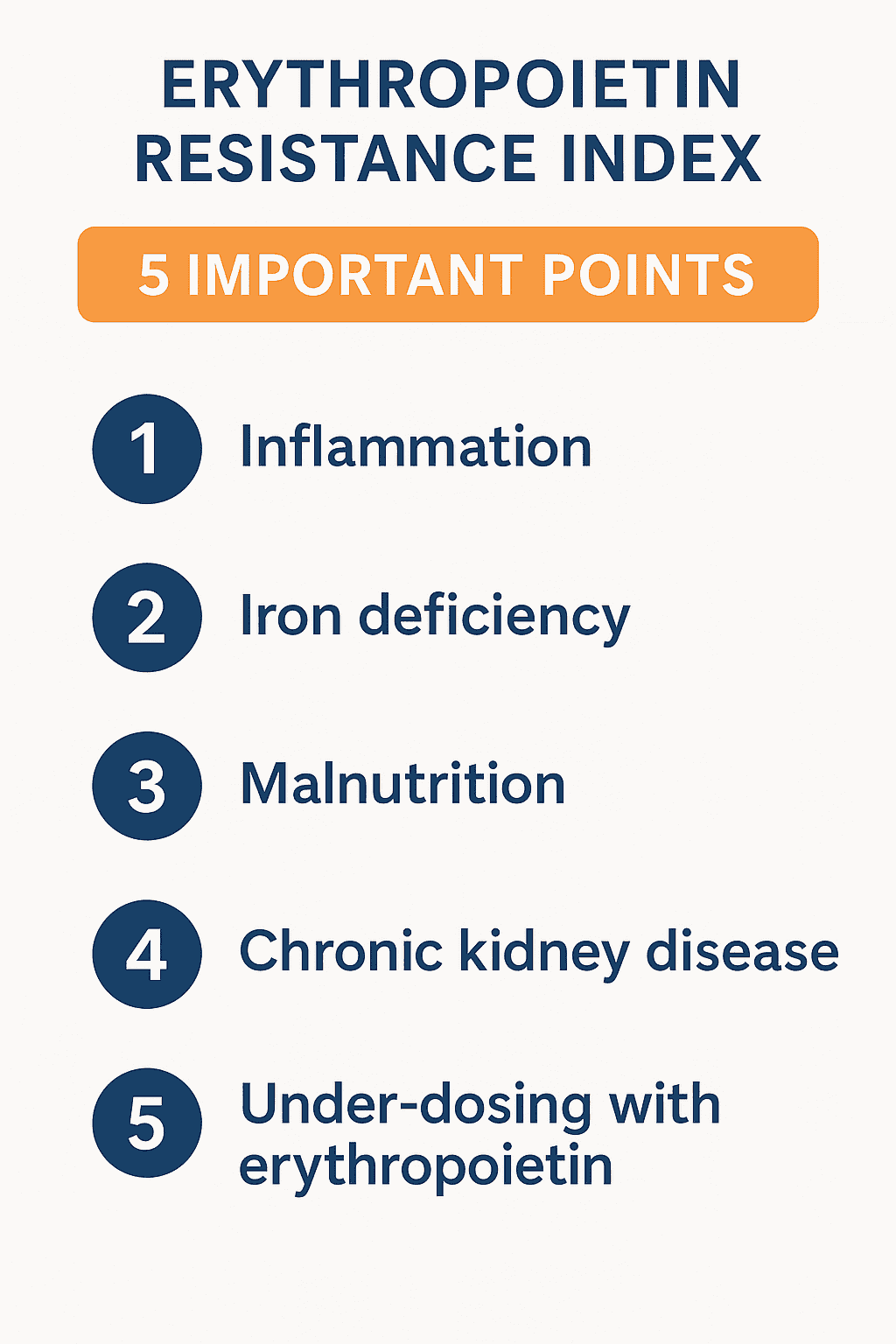
ERI — Advanced MCQs (USMLE / NEET-SS style) — 20 Questions
10 conceptual + 10 clinical vignettes — interactive, explanations on click
1. ERI is best described as:
A. Standardized weekly ESA dose per kg per g/dL Hb
B. Absolute weekly ESA dose irrespective of patient size
C. Hemoglobin divided by erythropoietin dose
D. TSAT divided by ferritin
Answer: A. ERI = weekly ESA dose / (weight × Hb), standardizing dose to body size and Hb level.
2. Typical ERI unit notation is:
A. IU/week
B. IU/kg/week per g/dL
C. µg/kg/day
D. g/dL per IU
Answer: B. ERI is represented as IU per kg per week per g/dL Hb (IU/kg/week/g/dL).
3. Which factor does NOT directly increase ERI?
A. Functional iron deficiency
B. Chronic inflammation
C. Increased dialysis adequacy (higher Kt/V)
D. Active infection
Answer: C. Better dialysis adequacy typically improves anemia management and would not raise ERI; the others can increase ERI.
4. Observational studies linking ERI to outcomes report that higher ERI is associated with:
A. Lower hospitalization rates
B. Improved exercise capacity
C. Reduced need for iron therapy
D. Increased mortality and cardiovascular events
Answer: D. Higher ERI often correlates with inflammation/comorbidity and worse outcomes including higher mortality.
5. When converting darbepoetin to epoetin equivalents for ERI, best practice is to:
A. Use validated conversion factors to express all doses in IU/week
B. Ignore darbepoetin doses and use epoetin only
C. Treat µg as equal to IU
D. Substitute darbepoetin dose directly into formula without conversion
Answer: A. Use accepted conversion ratios so all ESA dosing is comparable (e.g., convert µg darbepoetin to IU equivalents before ERI).
6. Which laboratory panel is highest priority when ERI rises?
A. Urine culture only
B. Ferritin, TSAT, CRP/ESR, and reticulocyte count
C. Serum amylase and lipase
D. Thyroid function tests only
Answer: B. Assess iron status and inflammation (ferritin, TSAT, CRP) and marrow response (reticulocytes) when ERI increases.
7. A persistent high ERI despite adequate iron suggests you should next:
A. Double the ESA dose indefinitely
B. Stop iron therapy
C. Investigate for occult inflammation, infection, hyperparathyroidism, or malignancy
D. Ignore and follow Hb only
Answer: C. After correcting iron, look for other reversible causes of resistance like inflammation, infection, high PTH, or blood loss.
8. Which drug class is known to potentially blunt erythropoietic response and raise ERI?
A. Short-acting benzodiazepines
B. Topical corticosteroids
C. Oral iron supplements
D. Some immunosuppressants (e.g., sirolimus, azathioprine)
Answer: D. Certain immunosuppressants can impair marrow response and contribute to ESA hyporesponsiveness.
9. In cohort studies, an ERI threshold frequently associated with significant resistance is approximately:
A. >10–15 IU/kg/week per g/dL
B. <1 IU/kg/week per g/dL
C. 0.1 IU/kg/week per g/dL
D. Negative values only
Answer: A. Many studies use thresholds around 10–15 IU/kg/week/g/dL to define higher resistance; cutoffs vary by cohort.
10. ERI is most useful clinically because it:
A. Replaces the need to measure Hb
B. Normalizes ESA requirement to weight and Hb allowing between-patient comparisons
C. Measures iron stores directly
D. Is independent of ESA type
Answer: B. ERI allows standardized comparison of ESA requirements across patients by accounting for weight and Hb.
11. (Vignette) A 58-year-old hemodialysis patient with CKD receives 8000 IU epoetin/week. Weight 60 kg, Hb 8.5 g/dL. What is approximate ERI?
A. 0.16 IU/kg/week/g/dL
B. 6 IU/kg/week/g/dL
C. 15.7 IU/kg/week/g/dL
D. 8000 IU/kg/week/g/dL
Answer: C. ERI = 8000 / (60 × 8.5) = 8000 / 510 ≈ 15.7 IU/kg/week/g/dL (suggests high resistance).
12. (Vignette) 45-year-old on peritoneal dialysis with rising ERI despite IV iron repletion, low-grade fever, CRP elevated. Next best step?
A. Discontinue dialysis
B. Increase ESA dose immediately
C. Schedule routine colonoscopy
D. Investigate and treat source of inflammation/infection
Answer: D. Inflammation is a common reversible cause of ESA resistance; identify/treat infection to reduce ERI.
13. (Vignette) A CKD patient with TSAT 12% and ferritin 80 ng/mL has ERI 12. Best management?
A. IV iron repletion if not contraindicated
B. Stop iron and wait
C. Ignore iron and double ESA dose
D. Immediate bone marrow biopsy
Answer: A. Low TSAT suggests iron deficiency; IV iron often reduces ERI and improves Hb response.
14. (Vignette) 70-kg dialysis patient on ESA, ferritin 600 ng/mL, TSAT 8%, ERI rising. Interpretation?
A. Absolute iron overload
B. Functional iron deficiency despite high ferritin
C. No iron problem
D. Immediate transfusion only
Answer: B. High ferritin with low TSAT suggests functional iron deficiency (inflammation-mediated iron sequestration) — treat underlying cause or give cautious IV iron per protocol.
15. (Vignette) A patient on sirolimus post-transplant has low Hb and ERI elevated. Which is most likely?
A. Sirolimus improves ESA response
B. Sirolimus has no hematologic effects
C. Sirolimus may cause marrow suppression contributing to ESA resistance
D. Sirolimus increases iron absorption
Answer: C. Some immunosuppressants (including sirolimus) can blunt marrow response and raise ERI; review meds as part of workup.
16. (Vignette) 60-year-old with CKD, rising PTH and ERI high. Which action may reduce ERI?
A. Ignore PTH
B. Increase phosphate intake
C. Stop ESA therapy
D. Treat secondary hyperparathyroidism (e.g., medical or surgical) which may improve anemia response
Answer: D. Secondary hyperparathyroidism can impair erythropoiesis; treating it may improve ESA responsiveness and lower ERI.
17. (Vignette) A 55-year-old on hemodialysis: weekly epoetin 7000 IU, weight 50 kg, Hb 10 g/dL. Calculate ERI.
A. 7000 / (50×10) = 14 IU/kg/week/g/dL
B. 7000 / (50×10) = 1.4
C. 50×10 / 7000 = 0.071
D. 7000 × 50 / 10
Answer: A. Calculation: 7000 ÷ 500 = 14 IU/kg/week/g/dL.
18. (Vignette) A dialysis patient on ESA has new GI bleeding and ERI increases. Immediate useful step?
A. Assume iron deficiency is unrelated
B. Evaluate for blood loss and consider transfusion/iron repletion as appropriate
C. Stop dialysis
D. Switch to oral iron only
Answer: B. Blood loss can increase ERI; investigate source, stabilize patient, and treat iron loss (IV iron/transfusion if indicated).
19. (Vignette) A patient with chronic infection has high ferritin (1000 ng/mL), CRP high, TSAT 15%, ERI high. Best interpretation?
A. Iron overload is the main cause
B. No treatment required
C. Ferritin elevated as acute phase reactant — treat inflammation and evaluate functional iron deficiency
D. Stop ESA permanently
Answer: C. Ferritin rises with inflammation; functional iron deficiency and inflammation commonly cause ESA resistance — manage underlying inflammation and consider tailored iron therapy.
20. (Vignette) Which composite approach is most appropriate for persistent high ERI despite optimized iron?
A. Keep increasing ESA dose without evaluation
B. Immediate bone marrow transplant
C. Discontinue all medications
D. Comprehensive workup: check inflammation, occult infection, meds, PTH, marrow studies if indicated, treat reversible causes
Answer: D. A systematic evaluation and treatment of reversible causes is the correct approach rather than reflexively escalating ESA or abrupt measures.
👍 MEDICINEQUESTIONBANK.COM
“Erythropoietin Resistance Index (ERI) explained for NEET-PG aspirants: learn calculation, interpretation, and its significance in anemia management.”
“NEET-PG guide: Understand Erythropoietin Resistance Index (ERI), its clinical importance, and application in chronic kidney disease anemia.”
“Master Erythropoietin Resistance Index (ERI) for NEET-PG with clear explanation, formula, and clinical relevance for effective exam preparation.”
“NEET-PG revision: Detailed overview of Erythropoietin Resistance Index (ERI), calculation methods, and its role in managing resistant anemia.”
“Erythropoietin Resistance Index (ERI) – NEET-PG revision guide.
Erythropoietin Resistance Index – explained: learn its calculation, clinical significance- Essential NEET-PG revision guide.”