Class I Indications for Coronary Angiography
Class I Indications for Coronary Angiography
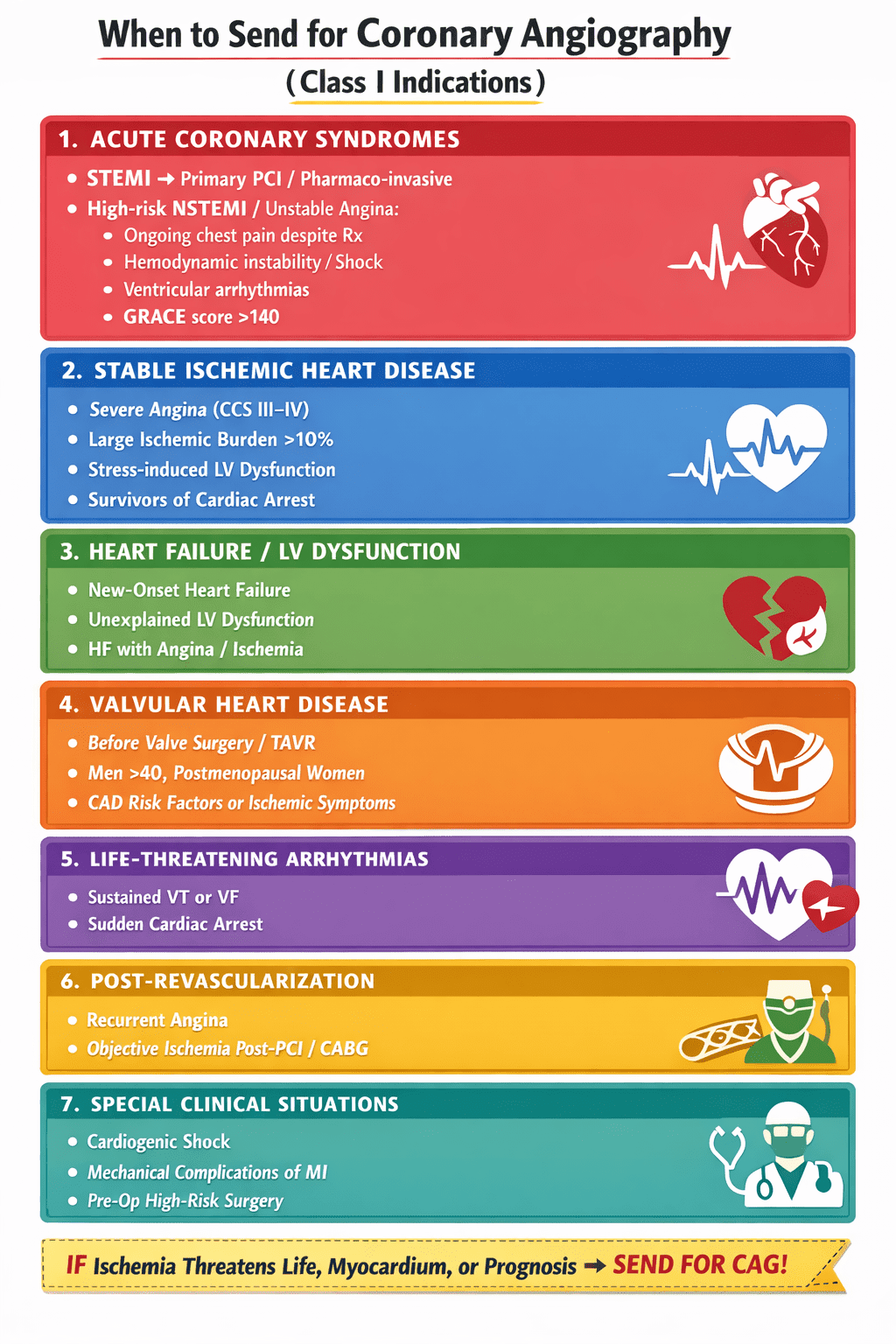
1. Acute Coronary Syndromes
- ST-elevation myocardial infarction (STEMI)
→ Immediate angiography as part of primary PCI or pharmaco-invasive strategy - High-risk NSTEMI / Unstable angina, including:
- Recurrent or ongoing ischemic chest pain despite optimal medical therapy
- Hemodynamic instability or cardiogenic shock
- Life-threatening ventricular arrhythmias
- Dynamic ST-T changes or significant troponin rise
- GRACE score >140
2. Stable Ischemic Heart Disease
- Severe angina (CCS Class III–IV) despite guideline-directed medical therapy
- High-risk findings on non-invasive testing, such as:
- Large ischemic burden (>10% myocardium)
- Stress-induced LV dysfunction
- Significant stress ECG changes at low workload
- Survivors of sudden cardiac arrest or sustained VT suspected due to ischemia
3. Heart Failure and LV Dysfunction
- New-onset heart failure with suspected ischemic etiology
- Unexplained LV systolic dysfunction where CAD needs to be excluded
- HF patients with angina or demonstrable ischemia who are candidates for revascularization
4. Valvular Heart Disease
- Before valve surgery or transcatheter valve intervention in:
- Men >40 years
- Postmenopausal women
- Younger patients with CAD risk factors or symptoms suggestive of ischemia
5. Life-Threatening Arrhythmias
- Sustained VT, VF, or aborted sudden cardiac death suspected to be ischemic
- Ventricular arrhythmias with evidence of myocardial ischemia
6. Post-Revascularization
- Recurrent angina or objective ischemia after:
- Percutaneous coronary intervention (PCI)
- Coronary artery bypass grafting (CABG)
7. Special Clinical Situations
- Cardiogenic shock suspected to be due to myocardial ischemia
- Mechanical complications of MI (e.g., papillary muscle rupture, VSD) requiring surgical planning
- Pre-operative assessment in high-risk non-cardiac surgery when ischemia is suspected and revascularization would change management
One-Line Exam Pearl
Any patient with ACS, high-risk ischemia, refractory angina, ischemic cardiomyopathy, or life-threatening arrhythmias has a Class I indication for coronary angiography.
1. Which of the following is a Class I indication for coronary angiography?
Asymptomatic patient with normal stress test
ST-elevation myocardial infarction within 12 hours
Low-risk stable angina controlled on drugs
Young patient with atypical chest pain
Primary PCI in STEMI is a Class I indication across all major guidelines.
2. Coronary angiography is Class I indicated in NSTEMI when?
TIMI score = 1
Recurrent ischemia despite optimal medical therapy
Normal ECG and troponin
Young age without risk factors
High-risk NSTEMI features mandate early invasive strategy (Class I).
3. Which stress test finding mandates Class I coronary angiography?
Large ischemic burden (>10% myocardium)
Isolated ST depression at peak exercise
Equivocal stress echo
Mild ischemia in one segment
High-risk ischemia on non-invasive testing is a Class I trigger for angiography.
4. Class I coronary angiography is indicated in heart failure when?
HFpEF with normal stress test
New-onset HFrEF with suspected ischemic etiology
Known non-ischemic cardiomyopathy
HF with normal coronaries previously
Unexplained LV dysfunction requires exclusion of CAD (Class I).
5. Which arrhythmic presentation requires Class I coronary angiography?
Isolated PVCs
Survivor of sudden cardiac arrest with suspected ischemia
AF with rapid ventricular rate
SVT responsive to adenosine
Ischemia must be excluded in life-threatening ventricular arrhythmias.
6. In NSTEMI, which scenario mandates a Class I early invasive coronary angiography?
TIMI score 2 without ECG changes
GRACE score >140
Troponin-negative chest pain
Resolved pain after nitrates
ESC and ACC/AHA guidelines define GRACE >140 as high-risk NSTEMI requiring Class I early invasive angiography.
7. Which STEMI-related condition carries a Class I indication for immediate coronary angiography?
Late presenter after 48 hours without symptoms
Cardiogenic shock irrespective of time delay
Small inferior MI with stable vitals
Post-MI pericarditis
SHOCK trial established Class I angiography in cardiogenic shock even beyond 12 hours.
8. Which stress test result confers a Class I recommendation for coronary angiography?
Stress-induced LV dilatation with fall in EF
Isolated inferior wall ischemia
Mild ST depression at high workload
Normal stress echo
Transient ischemic LV dysfunction indicates extensive CAD → Class I angiography.
9. Which patient profile represents a Class I indication for angiography despite stable symptoms?
CCS class II angina, good exercise tolerance
Survivor of aborted sudden cardiac death
Asymptomatic diabetic patient
Normal coronary CT angiography
Ischemic etiology must be excluded in survivors of SCD → Class I.
10. New-onset heart failure has a Class I indication for coronary angiography when?
EF preserved and BNP normal
Ischemic etiology cannot be excluded
Long-standing dilated cardiomyopathy
Normal coronary CT done 5 years ago
Guidelines mandate exclusion of CAD in unexplained LV dysfunction.
11. Which valvular heart disease patient requires Class I coronary angiography?
25-year-old woman with rheumatic MS
65-year-old man planned for aortic valve replacement
Young patient without CAD risk factors
Isolated mild MR
Men >40 years undergoing valve surgery require coronary angiography.
12. Which post-PCI scenario mandates Class I coronary angiography?
Recurrent angina with objective ischemia
Routine follow-up at 1 year
Asymptomatic patient
Mild atypical chest pain
Recurrent ischemia after revascularization → Class I angiography.
13. Which ventricular arrhythmia mandates Class I angiography?
NSVT in dilated cardiomyopathy
Sustained VT with ischemic ECG changes
Idiopathic RVOT VT
AF with fast ventricular response
Malignant ventricular arrhythmias with suspected ischemia → Class I.
14. Which perioperative scenario has a Class I indication for angiography?
High-risk non-cardiac surgery with unstable angina
Low-risk surgery with no symptoms
Elective surgery in asymptomatic patient
Good functional capacity
Unstable ischemic symptoms override surgical context.
15. Which ACS subgroup clearly benefits from immediate angiography (Class I)?
Low-risk UA
NSTEMI with refractory chest pain
Normal troponin
Negative stress test
Refractory ischemia mandates invasive evaluation.
16. Which trial supports angiography in cardiogenic shock?
COURAGE
SHOCK trial
ISCHEMIA
ORBITA
SHOCK trial established survival benefit of early revascularization.
17. Which imaging result alone is enough to justify Class I angiography?
Extensive anterior ischemia on nuclear scan
Mild inferior ischemia
Equivocal stress MRI
Normal EF
Large ischemic territory implies prognostic benefit from angiography.
18. In chronic coronary syndrome, which feature upgrades angiography to Class I?
Good symptom control
CCS class IV angina despite GDMT
Mild angina
Normal stress test
Refractory severe angina remains a Class I indication despite ISCHEMIA.
19. Which post-CABG scenario mandates angiography?
Routine graft surveillance
Recurrent angina with ischemia
Asymptomatic patient
Normal ECG
Symptoms + objective ischemia post-revascularization = Class I.
20. Which statement best summarizes Class I angiography indications?
Only for STEMI
Only after failed stress tests
Any high-risk ischemic presentation where revascularization may improve outcome
Only in young patients
Guidelines converge on risk-based, outcome-modifying indications.